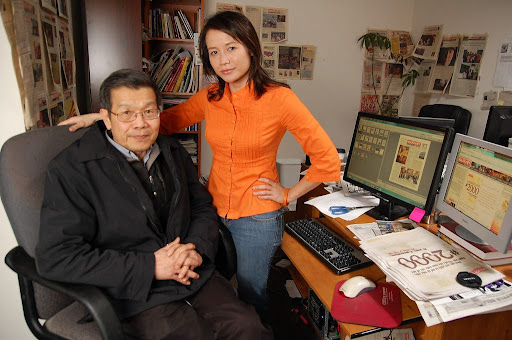
So much of what I learned about being the boss of my own life was from watching my parents, who founded the first privately-owned Vietnamese newspaper in the Pacific Northwest.
Here are 5 lessons I learned that can help you become the boss of your own life
Lesson 1: Love doing the work as much, if not more, than the product of the work itself.
We spend so much of our time doing the work. So, it’s really important that you enjoy the process and not just the outcome. I hear from some people that they are so relieved when the work is done and they dread starting to work again. That’s a bad sign. I am certain my father preferred the days preparing the newspaper more than the day the newspaper came out because by then, he was already thinking of the next issue. As for me, I started my own business so I could focus my energy on writing. I love the process of turning my original content into learning experiences.
Lesson 2: Choose who you work with, don’t do things alone.
This is easier to do when you are an entrepreneur versus when you are an employee. Working with people you collaborate well with can make a huge difference in terms of your effectiveness and feeling a sense of control over your life. For those of you who are entrepreneurs, remember, you get to choose. If you’re a manager and you have team members who you don’t think are a good fit, don’t feel guilty about letting them go. Even when you are an employee, be intentional about who you collaborate with. From the get-go, I knew I would work with a team (even if that meant paying them out of my own pocket). I knew that working with team members would enrich whatever I do. Even if you’re a solopreneur, you can choose your partners who help you serve your clients. Having collaborators keeps me accountable. I know we are working together on a shared purpose vs if I was working alone.
Lesson 3: With ups come downs, so be prepared to absorb the bumps financially.
A bad economic downturn can make you feel you’re really out of control. One way to prepare for possible downturns is by saving money. My experience of running the newspaper with my family during the 2008-2010 recession forever instilled in me a frugality that I carried even when I was an employee at well-resourced organizations. This enabled me to have the savings that gave me the financial freedom to invest in my own business. Save during the good times so you can weather the bad times. That approach helped me tolerate my significant losses in my second year of business. It also allows me to remain conservative despite significant gains as I enter my third year.
Lesson 4: Appreciate the value of freedom, and recognize the emotional cost of being micromanaged.
When I told my father I was going to leave my executive job at a remarkable nonprofit to start my own company in the middle of a pandemic, I was worried he would disapprove. Instead, he said, “I’m so happy for you. By having your own business, you are in control and you will have freedom.” I feel that now that I have my own company. Working for micromanagers in the past took a costly emotional toll on my confidence and sense of self-worth. So if you have a bad client, remember you can choose not to take their money. When you’re an employee, work for those who trust you and give you the freedom to do your job.
Lesson 5: Ask for help, so you can be in control of what kind of help you get.
At the start of my business, I had some people offer to help me by introducing me to free work for their team. That was their idea of helping me, but it wasn’t what I needed. I learned to be very specific about the kind of referrals to potential clients I’d like to get and I even provided an introduction text to help people help me. When you’re the one asking, you can be more specific. Otherwise, you may just take what people offer to you instead of what you need.
Which of these lessons resonates with you the most to help you become the boss of your own life? I’d love for you to share your thoughts in the comments section. If this was helpful, please share it with a friend or post it on social media.
Why Increasing Rejection Can Be Good For Your Business
As a business owner, hearing “no” can be painful and yet necessary. I actually think that it can be helpful for business owners to hear “no”. Here are three scenarios in which it’s actually good to hear “no”.
No to my sales pitch
If I’m not getting enough “no’s”, then I’m not pitching enough. I did an analysis of my close rate, and I realized I was getting an 80% win rate, which means eight out of 10 people who I asked said “yes” to my request. I realized that is way too high. It means that I’m actually not asking enough people. I was playing it safe.
What is your “win” rate? How many people say “yes” to you versus how many people say “no”? I am aiming to increase the number of people I ask, which will inevitably lower my win rate, but I’m okay with that because I’m expanding my overall potential to gain new business.
No to my price
If some people aren’t telling me that I’m too expensive, then I’m probably not charging enough. I have to be okay with some people not being able to afford my services, just like I’m okay with the services that I can’t afford, so I go with other options.
This also requires you to know what is your bottom line price that you need to make for you to feel valued and compensated. If you’re willing to lower your price, are you going to feel resentful afterward because you did so? Once I said no to a good project, but they changed their scope of work, and it would’ve been much more expensive. They were saying no to my price, and I was okay with not changing my price to accommodate their needs.
No to your method or idea
Not hearing “no” enough means that your content is too generic. Getting “no” means that you are not trying to please everyone and you can focus on what makes you special.
There is a popular sales book called Getting to Yes, about how you overcome objections in sales pitches, and negotiations. I actually think that it can be helpful for business owners to hear “no” and be grateful about it rather than being super pushy.
When I started out my business, I tried to get as many “yeses” as possible. Saying “yes” in the beginning could help us figure out what we’re doing. I asked “who is willing to pay me something?”, because something is better than nothing. As my business progressed, and I got more focus, I realized I couldn’t say yes to everything because it would mean taking focus away from the work that I started the business for in the first place. So, don’t be afraid of getting no. We don’t always have to try to get to yes. This recently happened to me when a prospective client said they were “too advanced” and CuriosityBased workshops weren’t helpful to those who were “further along in their equity journey.” They’re spot on. Their “no” reflected how they wanted training workshops, which takes participants through a linear progression of different levels of mastery.
CuriosityBased designs experiences to enable people to have vulnerable conversations so they can learn from one another instead of from a single instructor. People have taken the same CuriosityBased workshop over and over again with different people and still learn something new each time. The idea that people can be “being further along” conflicts with my philosophy on learning. (You can read more here). Understanding this potential client’s “no” reminds me it’s okay not to compromise or change myself to get to a yes.
When I hear, no, it makes me think, what am I willing to do to get yes? What are they telling me?
I’m not saying you should aim to have 100% “no”. When you hear “no” though, it means you’re pushing yourself out of your comfort zone, which is important for you to focus and grow your business.