banner

Unlock Your Creativity: The Power of Constraints

I fully appreciated how the power of constraints and limitations can unlock creativity when I returned to Seattle to run my family’s newspaper in 2008, the start of the global recession and decline of the newspaper industry. I was forced to be extremely scrappy and entrepreneurial as my parents and I tried to survive these unfortunate circumstances. That experience, though, informed how I approached my work later on. 

Here are 6 tips to help you think about constraints and limitations differently:

1. Accept that you have constraints and limitations so you can unlock creativity.

We might be tempted to dwell on what we don’t have or what we should have. It’s OK to feel upset. It is then that we move on and get to acceptance; that is where we can start the work. 

2. Focus on what you do have, not on what you don’t have.

While there are many things that we don’t have, they’re actually many things that we still have. My favorite story around this is with impressionist painters. A group of painters were painting together, and they realized they didn’t have any more black paint, so they started using violet. Then violet became the new black, the darkest shade. Without the color black, the impressionist paintings look so much more light. Here, they focus on what they did have, which was the color violet.

3. Focus on what you can try and experiment with.

Not having things can also make us experiment more. When we hold our learning experiences (what we call our workshops), we really like to have breakout groups so people can talk with one another. With some of our CuriosityBased clients, they don’t want any interaction with one another so I had to create a sense of interactivity without being able to rely on one of my go-to. We started to experiment with different kinds of polling to quickly get anonymous information from people. We would then show the results of those polls and have the people react to them. This constraint actually led us to improve the polling in our regular learning experiences that do have breakout groups. This limitation helped us improve overall.

4. Be clear about what you actually need to accomplish the work.

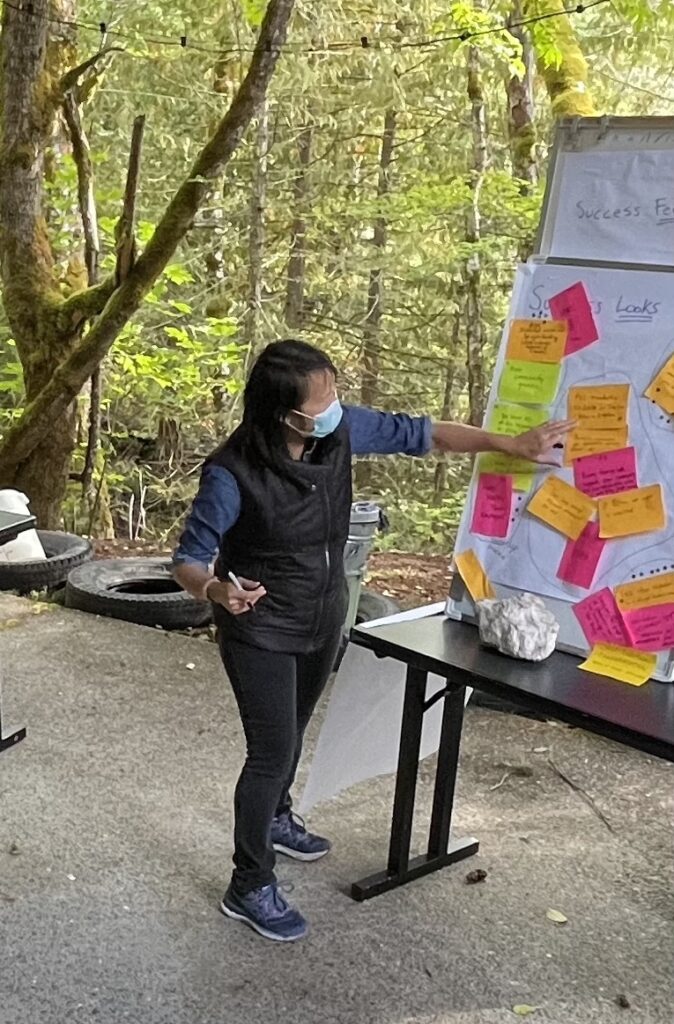
Sometimes we’re so used to things we think we need to have that we forget that we actually don’t really need them in order to do the work. For me, for example, I usually have access to a screen to project a PowerPoint slide deck when I am facilitating in-person sessions. So when I was asked to facilitate an outdoor session in a park, I couldn’t use my usual tech. Instead, we printed follow-along packets for people to consult. Turns out I didn’t need a projector after all. 
5. Trade products and services to get what you need.

When I worked at the newspaper, we had a lot of advertisers who had fallen behind on their bills, and also people who wanted to advertise and they just didn’t have the cash. We ended up doing a lot of bartering services like restaurant gift cards and printing services so we could each get what we needed.

6. Ask for help so you can get more resources.

I used to lead volunteer teams in building projects with no resources in a very short time frame. Some teams asked for donations, but I remember one team in particular wanted to organize an event and they ended up getting cupcakes donated, a free space, and volunteers to help. Once they expressed a need for help, people offered more than they had hoped for.

When we frame constraints as a way to force us to do things differently, that is when we discover our inner creativity. Which of these reframes resonates with you? I’d love for you to share your thoughts in the comments section. If this was helpful, please share it with a friend or post it on social media.

How to Help People Get What They Need: Become a Resource Connector

Many people, including myself, want to be helpful, although oftentimes we cannot help others directly because we don’t have the exact resources they need. The second best thing is to help connect people to the resources they need with those who have the resources to give.

Years ago, I went to a conference where the keynote speaker talked about how Oprah doesn’t promote herself, she promotes other people. She’s constantly uplifting and recommending other people. And in that way, she is a connector. That lesson has stuck with me. I’ve been able to build an extensive network in Seattle. It’s because I’m always just trying to connect people to the resources they need and to the people they should get to know.

I realize that I don’t need to be the center and have all the answers and provide all the resources myself if I can just be someone who helps connect people. When I ran a cross-sector fellowship, we focused on helping people learn how to be resource connectors. We asked this question: “What is something that you want to give? What is something that you need?” What people shared was very powerful.

You can be a resource connector.

It requires seeing everyone as having resources and also having needs.

It doesn’t matter how little money or little time you think someone has. Everyone has something to offer. And everyone has needs. Sometimes what they need and what they have to offer are the same thing.

What you’re really doing is connecting the dots. It requires a lot of asking questions and listening to people.

Here are the 6 steps to becoming a resource connector:

  1. Ask people if they have any particular resource that they want to share with others. You can ask, “Is there anything you want me to spread the word about or any resource you have to share?” Oftentimes the thing they’re asking for help from is the same thing that they are offering. For example, they may need help spreading the word about a special program that they lead. They’re also offering the resource of their program. So you may not even need to ask them if they have something that they want to share because they may have answered it within their ask for help. Sometimes people don’t like to ask for help, so they will just frame it as something that they are offering. I remember talking to a coding school founder who wanted to help people with their career transitions into tech.
  1. Ask those same people, “Is there anything I can help you with? I might not be able to help you directly, though I might know someone who can.” Sometimes they only want to offer help and yet their offer of help is actually an ask. In this case, offering to teach coding is also an ask for help with recruiting students. 
  1. See if there’s anything that they need that is related to something someone else offered. As you talk to other people, look for opportunities to connect resources with the people who might be good candidates for them. For example, someone may say that they are looking for a way to learn how to code and you just met someone who runs a coding program and is looking for students.
  1. Before you make the connection, reaffirm with the person who is offering the resource that they are still offering it. So, I asked the coding school founder, “Are you still looking for students?” She was. 
  1. Make the connection. It can be as simple as an email. 
  1. Bonus: Follow-up and check on if a connection was made. Sometimes I find out that one party never replied and I might nudge the to reply. At the very least, I know who is good to follow through and who isn’t and who I should and shouldn’t make connections for in the future.

Your efforts will generate goodwill and perpetuate a spirit of generosity. When people are helped, they will want to help others. And even if it doesn’t turn out exactly as people hoped, they were further along than before. 

For example, I talked to a friend, “Alex”, who is looking for a job as a project manager at a biotech and then I asked another friend who founded biotech if he would be willing to chat with this friend. It turns out that he was looking for a project manager and he interviewed my friend for the role. Although it didn’t work out, my friend got a lot further than he would’ve before.