banner

Leadership lessons disguised as kitchen tales from a self-described asshole

Review of David Chang’s Eat a Peach

Leadership, Identity, and Breaking the Model Minority Myth: Reflections on Eat a Peach by David Chang

I didn’t read David Chang’s memoir, Eat a Peach, because I’m a die-hard fan of Momofuku. I read it because there are so few memoirs by Asian Americans published by major houses. It took Chang four years to finish a book he first thought would be a “self-help manual on leadership.” Only after he accepted that he was writing a memoir could he complete it.

Any memoir written by a leader becomes, by default, a book on leadership. Chang, who helped reshape how Americans eat, stands as a pioneer in a mostly white-led restaurant industry.

This reflection explores the themes in Eat a Peach that resonated with me as an Asian American and the leadership lessons Chang conveys through his story.

Challenging the “Model Minority” Myth

In many ways, Chang’s memoir rejects the stereotype of Asians as “model minorities” — law-abiding, hard-working, highly educated, high-income earners who remain quiet, uncreative, and apolitical. He challenges the belief that Asians excel only as individual contributors or middle managers rather than as leaders.

Throughout the memoir, Chang expresses disbelief at his own success. At first, he thought he was suffering from imposter syndrome. Later, he recognized it as survivor’s guilt — the feeling that he succeeded while others did not. Few survive the brutal restaurant industry. He did, and he built his own platform.

That sense of survivor’s guilt mirrors how many Asian Americans feel after pushing back against parental and cultural expectations. Chang describes his father’s “distinctively conditional” love — a familiar form of tiger parenting that prizes achievement. Surviving both family pressure and systemic barriers makes the phrase “survivor’s guilt” fitting in more ways than one.

Craving More Asian American Voices

As a Vietnamese American, I crave more voices like Chang’s — raw, reflective, and deeply personal. His stories feel both familiar and distinctively Asian American. They evoke pride, yet also raise uncomfortable questions about identity and belonging.

Work as Identity and Addiction

Chang writes openly about workaholism, calling it a “socially acceptable addiction.” His work intertwined with his Korean identity. He admits, “I wanted not to be me… work made me a different person; work saved my life.”

He built Momofuku around challenging how Americans perceive Asian food. Working alongside his father — his first investor and business partner — became “the closest thing to therapy.”

Many Asian Americans can relate. I certainly can. After finishing my PhD, I returned to Seattle to work with my family’s Vietnamese newspaper. Like Chang, I knew working together would mean more time — and deeper connection — with my parents.

When Chang wrote that work saved him, it struck me. Is that passion? Fear? Or healing? Perhaps work, for many Asian Americans, becomes both a burden and a form of therapy.

Authenticity, Racism, and Asian Cuisine

Chang recalls classmates mocking the Korean food he brought to school. He says he’d rather see a white person want to make kimchi than dismiss it as strange.

In the culinary world, debates around authenticity and cultural appropriation appear constantly. Chang dismisses them as “boring,” but he also points out their racial bias. For example, diners may gladly pay $25 for Italian pasta yet refuse to pay the same for Asian noodles — even though they’re essentially the same dish.

That double standard runs deep, even among Asian Americans. Many will pay more for European cuisine but expect Asian food to be cheap. This raises a hard question: is that internalized racism? And do Asians need non-Asians to validate our food before we value it ourselves?

Romantic Relationships and Cultural Expectations

In the chapter “Grace,” Chang explains why he married another Korean American. His explanation made me pause. Why do so many Asian Americans feel the need to justify who they choose as partners?

Within the community, partner choices often become statements of identity. Marrying someone of the same ethnicity signals cultural pride. Dating outside the ethnicity — especially another person of color — can be seen as defiance or solidarity. Meanwhile, choosing a white partner is often viewed as assimilation.

These dynamics reveal the complex expectations Asian Americans face. Personally, when people assume my partner isn’t Asian, I feel a quiet satisfaction correcting them. It’s a small act of reclaiming identity and disrupting assumptions.

Leadership Lessons from Eat a Peach

Beyond identity, Chang models leadership through vulnerability and growth. His memoir offers lessons every leader can use:

  • Apologize with accountability. Chang admits to the anger he directed at his staff. He writes with remorse, acknowledging that forgiveness isn’t owed to him. True leadership accepts that others decide whether to forgive.
  • Be transparent. He doesn’t hide his evolution. Chang includes old correspondence to show how his thinking changed. For example, he admits that most of his references are about men, writing, “It’s my truth… but I wish some of it were different.”
  • Take risks. As a chef and entrepreneur, Chang constantly experimented. When launching a new restaurant, he wrote, “The only unifying thread was that we were nervous about every single dish we served.” Risk fueled innovation.

The Value of Imperfect Role Models

The memoir ends with “33 Rules for Becoming a Chef,” which read like life lessons. Yet what makes Eat a Peach powerful is its imperfection. Chang admits his flaws — his rage, ambition, and contradictions.

I appreciate that honesty. We need Asian American memoirs that allow room for imperfection. Letting Asian American “assholes,” as Chang calls himself, publish their stories expands what audiences see as possible. It opens space for complex, multidimensional portrayals of Asians in America.

In rejecting the model minority myth, Chang proves there are many ways to be a successful Asian American — while still embracing cultural identity.

Final Reflection

Chang never set out to be an Asian American role model. Yet by sharing his life so publicly, he became one. As an Asian in America, I hope my leadership also resonates beyond my community. We need more Asian leaders whom non-Asians look up to as well.

Chang proves that it’s possible — whether he intended it or not.n-Asians look up to as well. 

Chang proves it’s possible, whether he wanted to or not.

Interested in reading more? David Chang is featured on our AAPI-Authored Booklist!
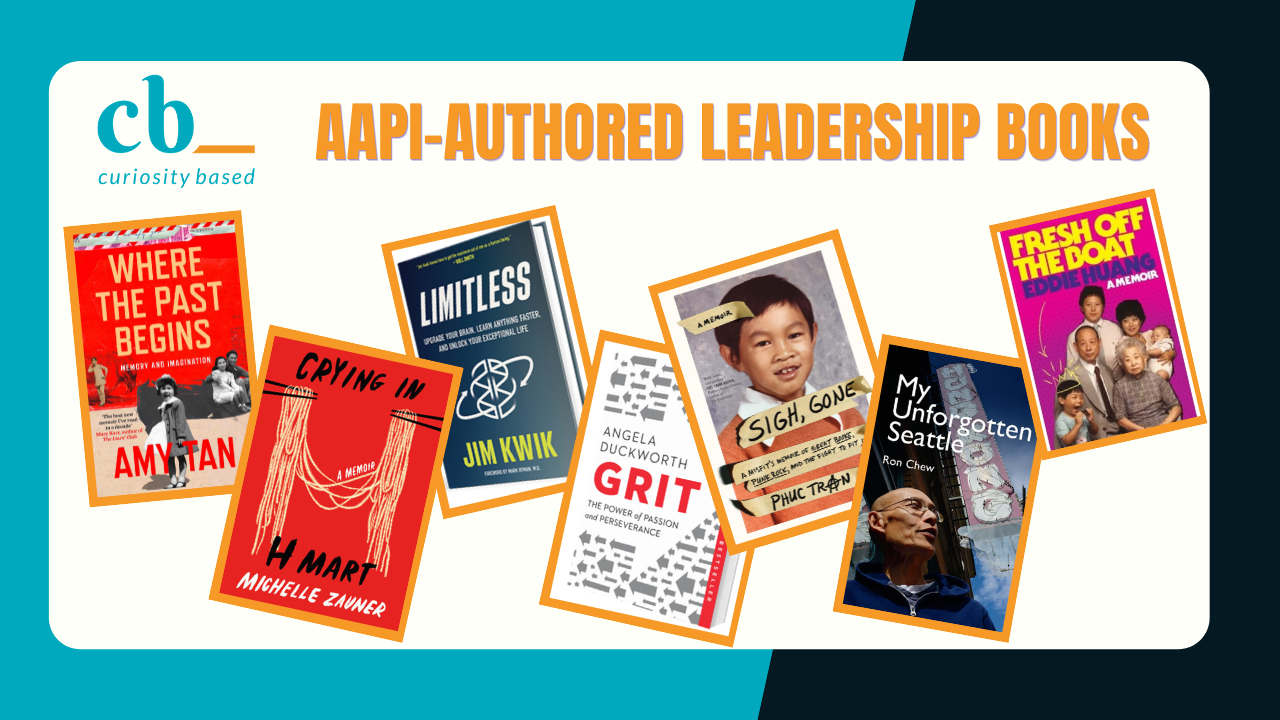
2021 AAPI-Authored Leadership Books

We created this list to promote leadership narratives written by Americans of Asian Pacific Islander (API) heritage. This list is meant to be a resource, not an official endorsement. The books are not ranked or listed in any particular order. 

(Download the PDF version of this list in the link above)

  1. This Is One Way to Dance by Sejal Shah
  2. My Forgotten Seattle by Ron Chew
  3. Sigh, Gone: A Misfits Memoir of Great Books, Punk Rock, and the Fight to Fit In by Phuc Tran
  4. Crying in H Mart: A Memoir by Michelle Zauner
  5. Living for Change by Grace Boggs
  6. Where the Past Begins: Memory & Imagination by Amy Tan
  7. Fresh Off the Boat: A Memoir by Eddie Huang
  8. The Cooked Seed: A Memoir by Anchee Min
  9. Out of the Gobi: My Story of China & America by Weijian Shan
  10. Love, Loss, and What We Ate: A Memoir by Padma Lakshmi
  11. Mixed Plate: Chronicles of an All-American Combo by Jo Koy
  12. An American Family: A Memoir of Hope & Sacrifice by Khizr Khan
  13. Brotherhood: Dharma, Destiny, and the American Dream by Deepak Chopra & Sanjiv Chopra
  14. Hawaii’s Story by Liliuokalani
  15. Nisei Radicals: The Feminist Poetics and Transformative Ministry of Mitsuye Yamada and Michael Yasutake by Diane C. Fujino
  16. See No Stranger: A Memoir and Manifesto of Revolutionary Love by Valarie Kaur
  17. Heart of Fire: An Immigrant Daughter’s Story by Mazie K. Hirono
  18. How to Raise a Feminist Son: Motherhood, Masculinity, and the Making of my Family by Sonora Jha
  19. Empress: The Astonishing Reign of Nur Jahan by Ruby Lal
  20. The Souls of Yellow Folk: Essays by Wesley Yang
  21. Dear Girls: Intimate Tales, Untold Secrets, & Advice for Living Your Best Life by Ali Wong
  22. Fault Lines: A Memoir by Meena Alexander
  23. Eat a Peach: A Memoir by David Chang
  24. Reset: My Fight for Inclusion and Lasting Change by Ellen Pao
  25. Grit: The Power of Passion and Perseverance by Angela Duckworth
  26. The Art of Stillness: Adventures in Going Nowhere (TED Books) by Pico Iyer
  27. The Art of Strategy: A Game Theorist’s Guide to Success in Business and Life by Avinash K. Dixit
  28. The Art of the Start 2.0: The Time-Tested, Battle-Hardened Guide for Anyone Starting Anything by Guy Kawasaki
  29. The Seven Spiritual Laws of Success: A Practical Guide to the Fulfillment of Your Dreams by Deepak Chopra
  30. The Checklist Manifesto: How to Get Things Right by Atul Gawande
  31. Limitless: Upgrade Your Brain, Learn Anything Faster, and Unlock Your Exceptional Life by Jim Kwik
  32. Postcolonial Leadership, A: Asian Immigrant Christian Leadership and Its Challenges by Hee An Choi
  33. Enough About Me: The Unexpected Power of Selflessness by Richard Lui
  34. Legal Heroes in the Trump Era: Be Inspired, Expand Your Impact, Change the World by Tahima Watson
  35. Hit Refresh: The Quest to Rediscover Microsoft’s Soul and Imagine a Better Future for Everyone by Satya Nadella
  36. All In by Jerry Yang
  37. Radical: Fighting to Put Students First by Michelle Rhee
  38. My Life in Full: Work, Family, and Our Future by Indra Nooyi
  39. Unprecedented: The Masters and Me by Tiger Woods
  40. Delivering Happiness by Tony Hsieh
  41. Be Water, My Friend: The Teachings of Bruce Lee by Sharon Lee
  42. Unsung Hero: The Col. Young O. Kim Story by Woo Sung Han
  43. You’re More Powerful Than You Think: A Citizen’s Guide to Making Change Happen by Eric Liu
  44. Holding Serve: Preserving on and Off the Court by Michael Chang
  45. Great Asian Americans: Michelle Kwan by Stephanie Cham
  46. Great Asian Americans: Ellison Onizuka by Stephanie Cham
  47. Great Asian Americans: Tammy Duckworth by Stephanie Cham
  48. Great Asian Americans: Patsy Mink by Stephanie Cham
  49. Great Asian Americans: Yo-Yo Ma by Stephanie Cham
  50. To The Stars: The Autobiography of George Takei by George Takei
  51. Big Little Man: In Search of My Asian Self by Alex Tizon
  52. I love a Broad Margin to My Life by Maxine Hong Kingston
  53. Dat: Tackling Life and the NFL by Dat Nguyen
  54. Courage: The backbone of Leadership by Gus Lee and Diane Elliott-Lee
  55. Madame Wu Chien-shiung: The First lady of Physics Research by Tsai-chien Chiang
  56. It Takes Moxie by Maureen Francisco
  57. Finding the Edge: My Life On The Ice by Karen Chen
  58. Rich Dad Poor Dad: What the Rich Teach Their Kids About Money That the Poor and Middle Class Do Not! by Robert T. Kiyosaki
  59. Still Life with Rice by Helie Lee
  60. I’m the One That I Want by Margaret Cho
  61. When Invisible Children Sing by Chi Cheng Huang
  62. Creating the Digital Future: The Secrets of Consistent Innovation at Intel by Albert T.c. Yu
  63. Boundaries by Maya Lin
  64. The War on Normal People by Andrew Yang
  65. Blue Ocean Strategy: How to Create Uncontested Market Space and Make the Competition Irrelevant by W. Chan Kim
  66. Leadership and Crisis by Bobby Jindal
  67. Enduring Conviction: Fred Korematsu and His Quest for Justice by Lorraine K. Bannai
  68. A Principled Stand: The Story of Hirabayashi v. United States by Gordon K. Hirabayashi
  69. Growing Up Brown: Memoirs of a Filipino American by Peter M. Jamero
  70. The Silent Master: Awakening the Power Within by Tae Yun Kim
  71. The Black Widow’s Guide to Killer Pool: Become the Player to Beat by Jeanette Lee
  72. My Forty years as a Diplomat by Feng-Shan Ho
  73. You Can’t Be Serious by Kal Penn
  74. Behind Deep Blue: Building the Computer that Defeated the World Chess Champion by Feng-Hsiung Hsu
  75. Not Nice: Stop People Pleasing, Staying Silent, & Feeling Guilty…And Start Speaking Up, Saying No, Asking Boldly, & Unapologetically Being Yourself by Dr. Aziz Gazupura
  76. The Truths We Hold: An American Journey by Kamala Harris
  77. Impressive First Impressions: A Guide to the Most Important 30 Seconds (And 30 Years) of Your Career by Vu H. Pham
  78. With Schwarzkopf: Life Lessons of the Bear by Gus Lee
  79. Purpose Mindset by Akhtar Badshah
  80. Conquering the Chaos by Ravi Venkatasan
  81. You Are A Mogul: How to Do the Impossible, Do It Yourself, and Do it Now by Tiffany Pham
  82. The Diversity Advantage: Fixing Gender Inequality in the Workplace by Ruchika Tulshyan
  83. Shorter: Work Better, Smarter, and Less – Here’s How by Alex Soojung-Kim Pang
  84. Minor Feelings: An Asian American Reckoning by Cathy Park Hong
  85. Come into my Office: Stories from an HR Leader in Silicon Valley by Mai Ton
  86. AugmentAsian: Strategies and Tools for Asian Pacific American Professional & Leadership Success by Asian Upward & Elevate Teams
  87. Edge: Turning Adversity Into Advantage by Laura Huang

We are continually adding to this list. If you have any recommended additions please send us an email at info@curiositybased.com so we can add it here.

Interested in reading more? Check out our Leadership Books Authored by Women booklist!

Read our other leadership booklists too!