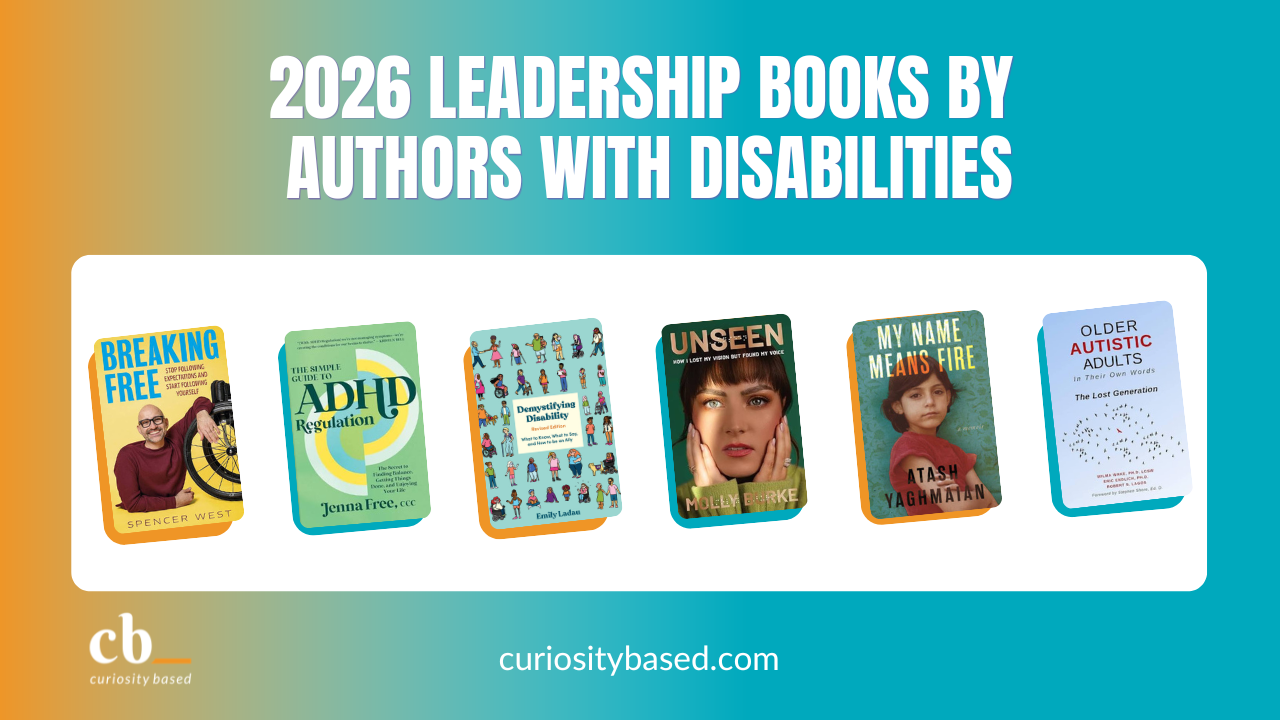
In honor of National Disability Employment Awareness Month, we updated our leadership book list and it now have 144 books, including memoirs, written by people who identify as having disabilities.
While researching this list, I discovered Unseen: How I Lost My Vision but Found My Voice by Molly Burke, a social media influencer, entrepreneur, and disabilities advocate.
At age 4, Burke was diagnosed with Retinitis Pigmentosa (RP), a condition that causes slow, progressive vision loss. Growing up, Burke was the cute poster child for a charity that conducted research for curing RP. She described herself as promoting “cure culture,” which aspires to fix people instead of celebrating them the way they are. By age 14, she realized that there was no cure for her and fell into despair. As an adult, she realized:
I was deeply entrenched in the medical model of disability…. It suggests that people with disabilities are broken, and that science and medicine can fix us. They want to heal us, to change us, so that we can fit into society better…. I now follow the social model. I no longer think that I am broken or not enough because of my blindness…My vision loss simply means I perceive the world differently from someone with 20/20 vision.
Burke’s evolution of thinking of herself as someone needing to be cured, versus someone who is blind, made me ask this question: What is something I’ve been thinking I want to fix because it’s different from what is considered “normal”?
My closest experience was in my teens and early 20s when I desperately wanted to be taller. I used to wear 4 inch platform heels, which made me 5’4”. While many people wear high heels because they like the look, I mostly wanted the height. High heels for me were a temporary fix, rather than the cure that I didn’t really need.
What is something you used to do, or perhaps still do, to “fix” or “cure” something about yourself to make you feel “normal”?
You can check out Burke’s memoir and other leadership books by authors with disabilities on our updated list from CuriosityBased. Huge thanks to Dr. Robin Nussbaum of We Do HR Solutions and Vanessa Laughlin of Banister Advisors for recommending many new titles to this list.
If you find this list valuable, please share it and spread the word. We put a lot of effort into these lists, and want the authors to get the recognition they deserve!
Here’s a sample message you can use when sharing this book list with your network:
Want to read leadership narratives written by Americans with disabilities? Check this out! (https://tinyurl.com/2026DisabilitiesBooks). #diverseleadershipauthors #DisabilityAwareness #NDEAM (National Disability Employment Awareness Month) #DisabilityPride #InclusionMatters #DisabilityRights #AccessibilityForAll #InclusionRevolution #DisabilityAdvocacy #DisabilityInclusion #BreakingBarriers #AccessIsLove
You can check out our other leadership book lists by those who identify as Hispanic/Latinx/Latino, Black, LGBTQIA+, AANHPI, Native American, and women.
Also, please send me any other recommendations you have for this list or any of our other lists.
Best,
Check out more CuriosityBased newsletters