Before you ask someone else for help, you have to get clear on what you’re asking for. No one can read your mind.
My favorite way to ask for help is using the SMART method, developed by Wayne Baker, a professor at the University of Michigan, from his book, All You Have to Do is Ask. I like it because it’s really clear and memorable. Just think about smart goals, and how popular that structure is. The smart goal is specific, measurable, actionable, realistic, and time bound.
A SMART has a lot of similarities to a smart goal.
The SMART method stands for
Specific
meaningful
action-oriented
realistic
Time-bound
Specific means that you’re asking for something specific, not for something vague or they have to guess.
Meaningful means that it’s personally meaningful to you. If this person were to say, yes, it would have a positive impact on you.
Action oriented means that the person can take action on it, that there’s something they can do. Yeah that doesn’t have to be physical. The action could just be. I want you to spend five minutes thinking about this.
Realistic means that with something that the person can realistically do. You’re not asking them for something that is really out of their means. For example, maybe you think they can lend you $500 but it might be difficult for them to lend you $5000. So be realistic about your ask. This is a personal assessment of the situation on your part. It’s not a discrete element of the ask itself.
Time bound means that you’re asking for it to be done by a specific time. So you might ask for something, but you don’t say when. When you’re asking for something and you want it done now, you may think that people understand that you mean “now” but if you don’t say it, they may not think it’s that urgent. Of all the elements of a SMART ask, this is the one that I often forget.
You can use this in your personal and professional life. Here are some examples I’ve used:
Since we live in the same suburb, would you be willing to give me a ride to this Friday’s event in Seattle? It will be really difficult for me to attend if I can’t get a ride.
Would you be willing to make introductions to organizational leaders who might be interested in hiring CuriosityBased for team building services? I’m really working on growing my business. To make it easy for you, I could give you some introductory text.
Are you available and interested in speaking on this panel for Leadership Tomorrow, an organization that I volunteer with? It will take about one hour of prep and one hour of actually speaking on the panel. It will take place on May 2 and I’d like to know by April 2 if you can do it.
So you can see that each of these asks have all of the elements of a SMART ask.
Try this for yourself. Go out and ask for what you need, just check if it has all of the elements of a SMART ask. Asking someone for help can feel uncomfortable, and having this structure might make it easier for you, because you’re focusing on the elements of the ask and not the feelings of hesitation or discomfort around making the ask itself.
I’ve written a lot about the benefits of asking for help. You can read more here.
6 Tips on How to Make the Most of Informational Interviews When You’re Looking For A Job
How to Make the Most of Informational Interviews
If you’re looking for a job, you might think the best strategy is to apply everywhere and talk to anyone who can help. However, in my experience, what I thought I wanted was not always what I truly wanted. Informational interviews helped me gain clarity.
What Is an Informational Interview?
An informational interview gives you insight into a job, company, or industry—and helps you get advice from someone already in that field. It’s a chance to make a strong impression on someone who might later connect you with others.
Importantly, an informational interview is not a job interview. Don’t treat it like one. If you do, you’ll likely feel disappointed. The goal is to learn, not to get hired immediately.
My Experience with Informational Interviews
I’ve done many informational interviews throughout my career. When I transitioned from working at my family’s newspaper to big tech, I spoke with five new people each week for eight weeks—forty interviews total.
These conversations helped me refine what kind of career I wanted. They also gave me new language to describe my skills. For example, someone might tell you that what you call a “coordinator” role is known as a “project manager” in their industry. Small insights like that help you talk about your goals more clearly and discover roles you didn’t even know existed.
Make a Positive Impression
An informational interview is also your chance to leave a good impression. Show that you’re smart, articulate, and curious. Ask thoughtful questions and listen closely.
If you come across as pushy or unprepared, people will hesitate to introduce you to others. But if you’re engaged and attentive, you’re more likely to expand your network naturally.
How to Get Informational Interviews
Start with your network. Reach out to friends, volunteers, mentors, and colleagues for introductions. Form a small group of accountability partners who can help you find connections.
I rarely do cold outreach, so I focus on referrals and warm introductions. If you want more strategies, check out my blog post on Six Tips to Get a Job You Love.
Tips for a Successful Informational Interview
1. Do Your Research
Before the conversation, spend a few minutes learning about the person. Review their LinkedIn profile, company website, or recent talks. Mention something specific—like “I watched your panel discussion on career growth”—so they know you came prepared.
Avoid basic questions such as “What do you do?” That shows you didn’t prepare and wastes valuable time. Doing your homework signals professionalism and helps you ask more meaningful questions.
2. Prepare Three Specific Questions
Some informational interviews last an hour, but others might be just 15 minutes. Prepare for the shorter version. Think of three focused questions that are relevant to your interviewee.
For example: “Since you’ve worked in corporate settings for years, what advice would you give to someone transitioning from nonprofit work?”
When I once asked a Director-level professional a question like that, he later referred me for a job. His recruiter note said, “She’s a precise, concise communicator and a clear thinker.” That’s the impression you want to make.
3. Ask for Referrals
If the conversation goes well, ask whether they can recommend anyone else you should talk to. They may not think of someone right away, so follow up later.
To make it easier, write an introductory blurb they can forward. Many people forget this step, but it’s crucial. If you’re not willing to write your own blurb, it’s harder for them to use their social capital to connect you.
4. Offer to Help Them
At the end of the interview, ask if there’s anything you can do to help them. Even small offers matter and show that you were listening.
For instance, if they mention their child plays in a youth symphony, you could share information about a music program. Or if they love a certain cuisine, you might offer restaurant recommendations.
I always appreciate when people ask this question—it shows generosity. Personally, I often suggest they subscribe to the CuriosityBased newsletter or follow our social channels.
5. Follow Up with a Thank-You Email
Always send a thank-you email after your interview. Reference something they said to show you listened. If you forget, don’t worry—it’s never too late. A quick note such as, “I’ve been meaning to thank you for our conversation last month” still makes a great impression.
6. Keep Them Updated
If they introduce you to someone, follow up to let them know how it went. A short message like, “Thank you again for the introduction. We spoke last week, and it was a great conversation,” helps strengthen the relationship.
And when you eventually land a job—even if it’s in a different field—send an update. People appreciate knowing their effort made a difference.
Final Thoughts
Informational interviews are one of the most effective ways to explore careers and build meaningful professional relationships. When you approach them with curiosity, preparation, and gratitude, they can open doors you didn’t even know existed.
I hope you’ve had these tips helpful. If you did, please share on social media and with your friends.
Since the layoffs started last fall, I know a lot of talented people looking for work.
I empathize. I’ve been laid off twice, in 2012 and 2014. Before that, I had to prove I could work in the corporate world when my work experience was limited to academia and working at my family’s newspaper. In 2011, I met Paul Anderson, the founder of Prolango, a career search firm. I invested in the Prolango job search boot camp and followed the Prolango method, which emphasizes intense networking, and I landed my first 6-figure salary job two months later.
I don’t think applying to jobs through online portals works. I did that for six months and only got a few invitations for candidate screens that went nowhere, despite my Cambridge PhD and my experience working at two established tech companies. The last time I got a job outside my network was as a research assistant in college. That’s why I can empathize with those trying to switch their careers, get a new job after a layoff, get their first job out of college or grad school, or find a job that will sponsor their visa to stay in the US.
Over time, I developed some of my own job search tips honed from my own experience, in addition to Prolango’s.
1) Outreach to people you know first.
You have to be willing to check in and ask your existing network to help you expand your network. The way I like to do this is by creating a newsletter, that is, an update email about what’s happening in your life. Some people will create a PDF and email this out. I actually like to write a text email with various links that people can click OK if they’re interested in learning more. This update email should include personal and professional updates about you, like “I just graduated from school and I’m looking to do this” or “I just left my job” along with details like, “this is where I’m living now, this is how my family is doing and this is how I’m doing healthwise”. You have to be willing to share enough personal details so that the email feels personal. I like to include both highs and lows.
I recommend sending this email through your email provider using a mail merge app. If you’re on Outlook, you can use the built-in mailmerge app. I’m a huge fan of yet another mail merge, which is a plug-in for Gmail. It’s free for up to a certain number of emails to send out every day. A merge field is that personalized part of an email, like a person’s name. I always have a personal note merge field in the opening paragraph. When I think about who I should email, my rule of thumb is that I need to be able to write about something personal in their life. It could refer to the last conversation we had or to something I saw on their social media. I need to be able to say something like, “How is your daughter? Last time we talked, she was graduating from high school.” If I can’t think of something personal to write, I won’t write. Including a personalized line does take a lot more effort, and I also think it’s a lot more effective.
2) Volunteer as a way to network, learn, and get endorsed.
I’ve made some major career pivot in my life, going from academia to working at my family’s newspaper to working in tech as a digital marketer, and then as a nonprofit executive, and now as an entrepreneur. My academic background is as a historian, which is very specialized and not directly relevant to what I do today. I made up for this by volunteering so that I could gain new skills by doing, and also to expand, see what might not work. I volunteered to head marketing for the local chapter of the National Association of Asian American Professionals (NAAAP), even though I had just joined social media a few months prior and I had never blogged before. I joined a lot of other committees and boards of small nonprofit, so that I could have a platform to learn by doing. The great thing about volunteering is that unless you do something illegal, they’re not really going to fire you. I learned so much about selling when I served on a committee for a concert at Seattle Symphony, and the other volunteers, who are much more senior in their career, mentored, and coached me on how to sell.
The other benefit of this is that by doing a good job as a volunteer, you have people who can endorse you later on, and who are willing to introduce you to people. So, even though I had no formal marketing experience, I learned enough where I was able to lead this Seattle chapter to place number #1 in the country in marketing at the national NAAAP convention. And I cited that experience as proof of my ability to learn on the job.
3) Do a lot of informational interviews.
An informational interview is a conversation where you learn about someone’s specific job, industry, and expertise, and it also gives them an opportunity to learn about you. It’s not intended to lend you a job, though it may. You’re really just getting background information. My friend, Paul Anderson, the founder of Prolango consulting, which helps people find their dream jobs, gave me this formula for how many informational interviews: He said if you wanna get a job in three months, you reconnect with five people a week you know. If you want to get a job in two months, you have five informational interviews per week with people you don’t know. And if you want to get a job in one month, you talk to 10 new people each week. I did the two month version, and I consistently had five informational interviews per week and I was able to land my first six-figure salary job at a major tech company, after working 60 hr a week for my parents for about $1,500 a month plus free rent. As you meet people, always in the conversation, asking if they think that there is someone else that they could introduce you to. The point of these conversations is not to get a job, the point is to increase your opportunities to make a good impression on someone who could introduce you to someone who could give you a job. I’m going to write a separate blog post and video about informational interviews, so subscribe to our YouTube channel to get alerts.
4) Write short bios about you that are easily share-able.
As you meet people, make it really easy for them to introduce you to other people. I like to prepare a short, 4 to 6 sentence bio that is personalized with a specific ask. Create a generic boilerplate version, and then always personalize the last sentence of it. When people ask me to connect them with someone in my network, I always ask them to write this in third person so I can copy and paste it and it looks like I wrote it. The bio should be short and impressive. It’s more powerful if you can include a sentence about why you want to meet that particular person.
Here’s an example:
Kim Doe Is an experienced lawyer who has worked at (companies) for the past (number of years). She specializes in (various specialties). She has been recognized for (listening awards, recognitions). She is now Interested in pursuing a career in (new field). She would like to talk to you about (specific questions/topics Kim would ask)
Make it really easy for the person that is going to introduce you. Also, you get to emphasize what you want to emphasize with, not have them guess.
5) Find other job seekers as networking partners.
Looking for a job can be very lonely and depressing. One of the key things that I learned with Prolango was to have a small group of accountability partners. Part of the Prolango job search Boot Camp was having to report every week how many people I reached out to, who I met with, how those meetings went, and what I learned. The mere fact that I knew I had to do made me more likely to do the work of reaching out to get the informational interviews. These accountability partners could be looking for similar jobs, or they could be looking for very different jobs. That’s up to you. As they are networking, they can be listening for opportunities for you, and you can be listening for opportunities for them. It’s just getting more people out there to be your eyes and ears. They can also commiserate with you when times get hard.
6) Write a proposal about why you’re right for the job.
In one informational interview, I talked to the CEO of a big company and asked him for advice. I will never forget his words. He said, “You’re very smart, and have an impressive background. And there are a lot of people who are very smart, and have impressive backgrounds. You have to tell me what value you are going to bring to my company.“ A lot of people want to help, but you have to be clear about how you’re going to help them. If there is a job or company that you really want to work for, then writing a proposal about the value you could bring would be a good exercise to help you think through what you would do with the company, and also to demonstrate to your potential future employer, your ability to think critically, and to communicate through writing.
Ideally, you write the proposal after you’ve had a chance to talk to some people at the company so you can get a little more information for which you could base your proposal. In the proposals I’ve written, I like to include a list of reasons why I am perfectly suited for that company, why I am physically interested in it, a SWOT analysis of the company, and what my unique skills could do to address the challenges and needs of the company. Bonus: include a timeline of when you think you can do it by.
If you’re already at the interview stage, you may also want to set salary expectations. My proposals have been 4 to 5 pages, which may sound long, but you’re actually giving extra evidence to people that’s why they should hire you. I’ve also been on the receiving end when someone voluntarily put together a proposal and it’s sealed the deal for me.
I hope that these job tips have been helpful. Even though I have my own company now and I’m not looking for a job, I still have a practice of sending out an update email every 12 to 18 months and I still volunteer so I can build new skills. Please leave comments below about which tips you found most valuable.
You can also watch short video versions of this blog post along with other job search tips on our YouTube channel. Please subscribe to get alerted when that video comes out.
We assume that “training” and “learning” are the same, when they are not. Learn how they are different and which one is a better fit for your needs.
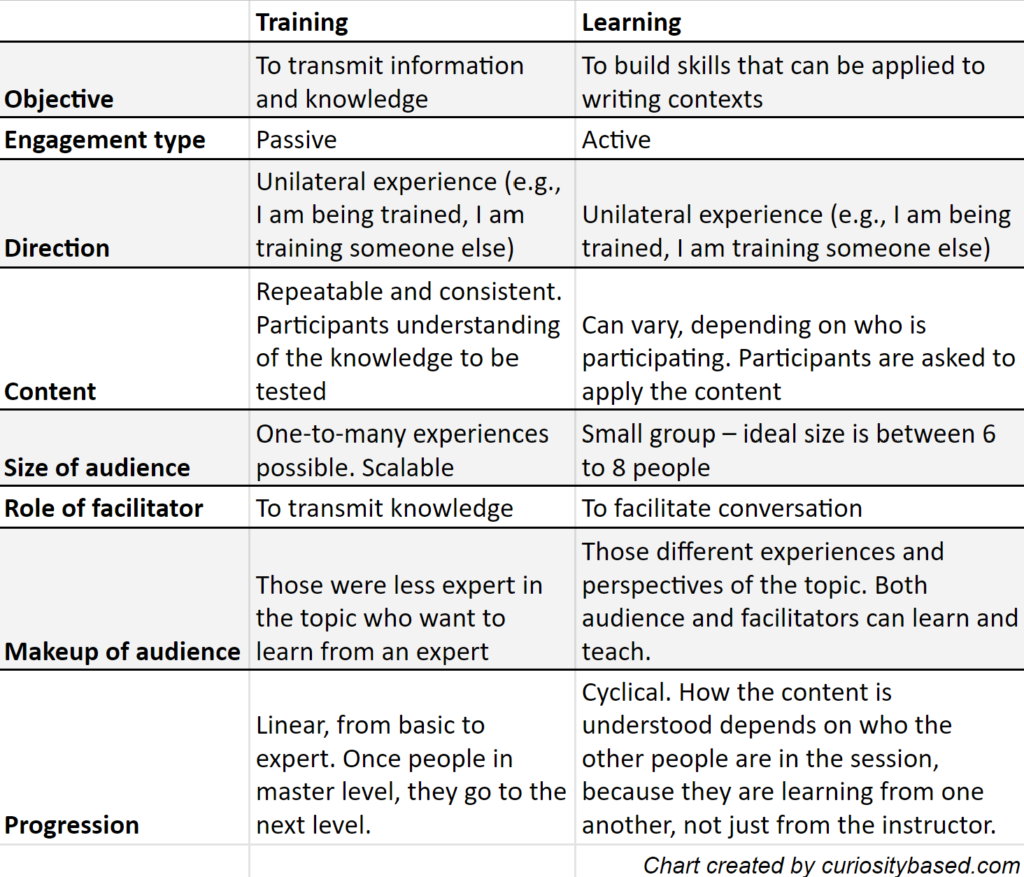
If you can’t explain the difference between training and learning, you aren’t alone. You likely use these words interchangeably, as I have, or know there is a difference, but you might struggle to explain what that difference might be. I looked up the definitions:
“Training” is about transmitting knowledge or information, while “learning” is about the process of absorbing information to build skills that can be used in a variety of contexts.
With “training,” you’ll get information. For a lot of people, getting information is enough, especially if you already know how to apply knowledge. “Learning” is equivalent to building critical thinking skills. A lot of people assume they’re the same when they’re not. You may also think of the difference between the two as “training” being “passive learning,” while “learning” is “active learning.”
Training Versus Learning
Employers say they want “training” for their teams. That might be because we often describe anything educational in the professional setting as “training.”
While I outline these two categories below, I understand that there are many professional development offerings that fall in between the two poles. There are many classes that provide training with strong learning elements to practice what is being taught.
I’m a big advocate for “learning” experiences over “training.” The difference can be summed up with this comment we heard from a participant in a learning experience I held on listening effectively. She said, “I’ve been to a lot of trainings about how to listen, where we just sat there, listening to the instructor tell us how to listen better. This is the first time I’ve spent practicing listening in a training about listening.”
Professional development is dominated by training to the point that if people don’t get a massive list of new vocabulary and worksheets, they don’t think they are learning anything new or valuable.
When I take people through a learning experience, I use the Socratic method, and I ask lots of questions to stimulate critical thinking and invite people to draw out their own learning. I’ve had people leave learning experiences I’ve led saying, “I now have more questions than answers.” That can be incredibly frustrating for some people, and eye opening and empowering for others.
At the end of a training session, If you asked the participants what they learned, the answers should be fairly consistent And they came to be tested on their knowledge. With the learning experience, I ask people to describe a take away. I’m always surprised by how people have different takeaways and I as a facilitator and content creator get to learn something as well. One person described this closing reflection as “naming our own meaning.”
Choosing What’s Right For You
There are times when training is the more appropriate choice and other times when learning is what is needed. These questions are designed to help you determine what you need to give to your team, especially while many of us are working remotely.
Do you need to deliver the same content to as many people as possible at one time or can you have multiple sessions with smaller groups of people?
Do you prefer people to something in a particular way or are you open to different ways of achieving the same/similar results?
Do you have deep trust across your different departments or are you looking to build more trust across silos?
Are your employees asking you for more content to help them do their work better or for more connection with each other?
Is your team or company made up of individual contributors or collaborators?
Do you want your team to have a shared language or a shared culture?
Are you prioritizing serving external clients or internal clients?
Are your team members more interested in listening passively or engaging actively?
If you mostly chose the first choice, then training is probably a better option for you. If your answers fell primarily toward the second choice, then you should explore learning experiences.
Prior to the pandemic, when we could be in person with one another, a good training was an efficient way to transmit substantial amounts of content. We took for granted the connection that came from being physically present together. Now, as we work remotely, taking the time to slow down and learn from and alongside one another allows colleagues to connect meaningfully. Before you default to training, explore what learning experiences could do for your team.
What I learned in managing expectations with others and with myself
Feb 1, 2022 to Jan. 21, 2023 marked the Year of the Tiger. This is a display at Wing Luke Museum.
In my second year as an entrepreneur, I learned a lot about how to manage expectations with others and especially managing my own expectations of myself.
Managing expectation is a never ending exercise in clearly articulating our needs, wants, and hopes. It requires activating all three elements of practicing curiosity: self- awareness, relationship building, and communication.
Here’s what I learned to help me navigate the dynamics of managing expectations that I’ve applied to both my personal and professional life.
Don’t expect people to change, yet believe them if they do change
Changing behavior is difficult for those who want to change, and impossible for those who don’t want to change. I’ve learned not to expect people to change. At the same time, people can change and I have to let go of grudges and old expectations to believe that they have changed. This has been especially true in my personal life. I’ve seen my mom change after my dad passed, in positive ways I didn’t expect. Just as I want others to see that I am capable of change, I have to be willing to believe others can change too, even if I shouldn’t expect it.
Explicitly describe what people can expect from me
I have to constantly remind myself that people can’t read my mind and I have to be more explicit. In regards to their own expectations, some people think in terms of what they will gain and benefit. For my clients, I describe what they will get with specific examples. For my team, I try to anticipate their questions and concerns. This is especially important now as people worry about layoffs. For my friends, I let them know what kind of support I can provide.
Explicitly describe what people shouldn’t expect from me
Other people think in terms of what they might lose or won’t get, so I also list what I won’t be doing and what they will not get, so that I can manage their expectations. For example, I often tell people my 7 Forms of Respect framework will NOT teach them how to be respectful, that it’s not like 7 Habits of Highly Effective People. For my team, I’ve made it clear that until we become consistently profitable, I can’t increase hours or provide more benefits. For my friends, I let them know when I can’t provide support in the ways they asked of me.
Accept that people will have expectations of me I can’t fulfill
It’s natural for people to make assumptions about me that lead to certain expectations. I have found that people often think because I’m a woman of color in leadership development, my work will focus on diversity, equity, and inclusion (DEI) when it doesn’t. I don’t get upset by this expectation; I just explain that I’m not a DEI expert.
Name incorrect expectations
Painful learning experiences made me learn how to name incorrect expectations before I reset their expectations. For example, I now sometimes start workshops with, “You may think this is racial justice training and it’s not. This is what we’ll be doing instead and why.”
Ask people to manage my expectations by managing theirs
In being clear that expenses outpaced revenue this past year, I tell my team that I understand they have to consider their individual financial needs because I don’t know when I can provide higher salaries. I just ask them to keep me updated if they do search for work elsewhere. When a team member left for a great career opportunity, I was not surprised. My expectations were managed.
Differentiate between expectations and hope
Entrepreneurship requires optimism. I was wildly overly optimistic in my revenue projections coming into my second year. I realized expectations should be based on my previous experiences to believe what is realistic and possible, not from strangers’ success stories I read on the Internet!
Don’t compare myself to others in creating expectations for myself
This is a hard one to admit that I do. I constantly have to remind myself not to compare. I have
close friends who are also authors of wildly successful books. As a self-published author without a long track record of prestigious publications or public speaking, I can’t apply the same expectations for success to myself. If I only look at those who I think have more, I will always feel I don’t have enough. So, I can’t compare.
Continue to do things I love even if they don’t meet my expectations
There are so many things I love doing, such as writing essays like this, that don’t meet my expectations of desired outcomes. I often remind myself that I don’t write because I expect a lot of views; I write to have an impact, even if that impact is limited to a few readers. Think about what things you love to do and that you would do no matter what, even if they don’t live up to your expectations. This lesson is also connected to the one on differentiating between expectations and hope (see lesson #7).
Lower my expectations to “good enough” so I can experiment faster
I sometimes slip into perfectionist standards. This past year, I pushed myself to create content with less and sometimes no outside editing before I post. I’ve been surprised by how my raw content can resonate with people, like my 2021 reflections on managing my energy instead of my time or my Instagram reel that went viral when I made fun of myself. This lesson is one I will lean into even more in 2023.
I’ve learned to accept that managing expectations is an iterative process in which I have to be asking questions and listening carefully to both others and to myself.