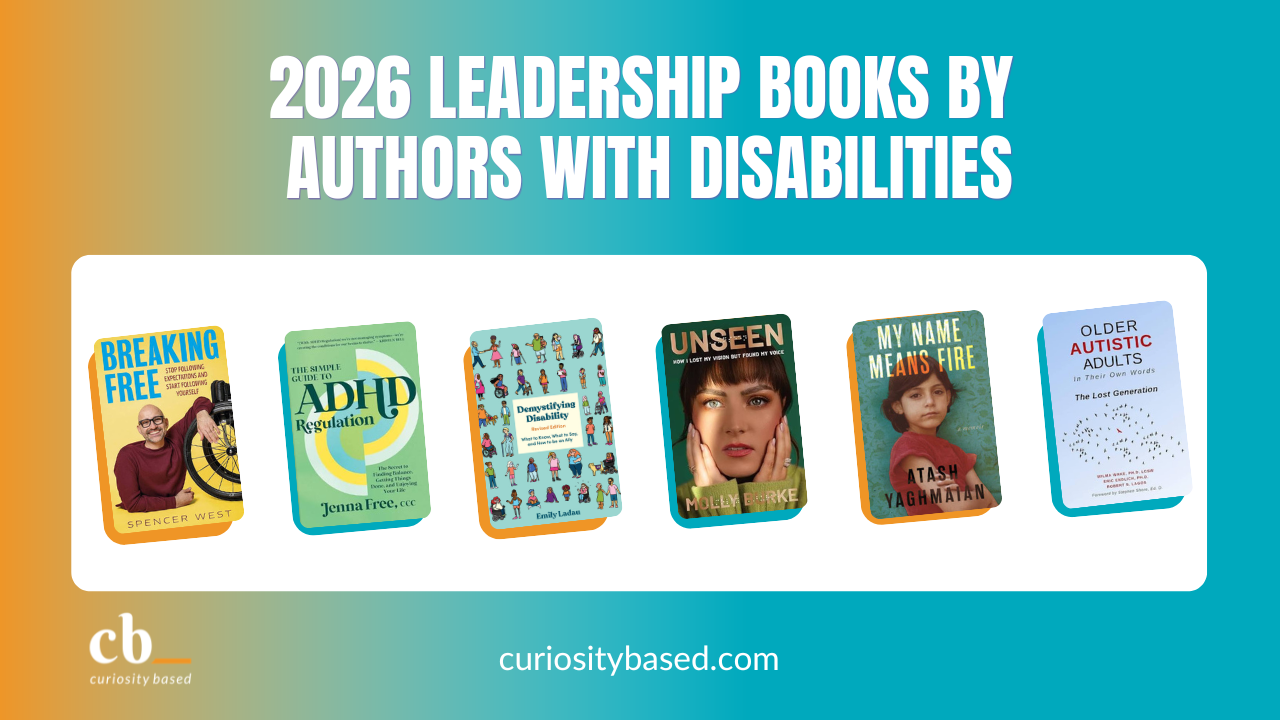
In honor of National Disability Employment Awareness Month (NDEAM), we curated this list to promote leadership books by authors with disabilities. This list is meant to be a resource, not an official endorsement. The books are not ranked or listed in any particular order.
Check out our other leadership book lists by authors who identify as LGBTQIA+, AANHPI, Native American, women, and Hispanic/ Latino/ Latinx.
- A Body, Undone: Living On After Great Pain — Christina Crosby
- A Face for Picasso: Coming of Age with Crouzon Syndrome — Ariel Henley
- ADHD Advantage, The: What You Thought Was a Diagnosis May Be Your Greatest Strength — Dale Archer, MD
- Adult ADHD: How to Succeed as a Hunter in a Farmer’s World — Thom Hartmann
- Aftershocks — Virginia Eubanks
- An Unquiet Mind: A Memoir of Moods and Madness — Kay Redfield Jamison
- And Now We Are Going to Have a Party: Liner Notes to a Writer’s Early Life — Nicola Griffith
- Apocalyptic Best Practices: A unique approach to fear and change — Elisebeth VanderWeil
- Articulate: A Deaf Memoir of Voice — Rachel Kolb
- ASL Saved My Life…Until it didn’t — Jenni Kleinman Berebitsky
- Authentic: The Myth of Bringing Your Full Self to Work — Judy Ann Burey
- Be Different — John Elder Robison
- Being Heumann: An unrepentant memoir of a disability rights activist — Judith E. Heumann
- Black, Blind, In Charge: A Story of Visionary Leadership — David A Paterson
- Bless the Blood: A Cancer Memoir — Walela Nehanda
- Blind: A Memoir — Belo Cipriani
- Body Silent, The: The Different World of the Disabled — Robert Francis Murphy
- Body Weather: Notes on Chronic Illness in the Anthropocene — Lorraine Boissoneault
- Body, Remember: A memoir — Kenny Fries
- Brain on Fire: My Month of Madness — Susannah Cahalan
- Breaking Free: Stop Following Expectations and Start Following Yourself — Spencer West
- Brilliant Imperfection: Grappling with Cure — Eli Clare
- Calling all Minds: How to Think and Create Like an Inventor — Temple Grandin
- Care Work: Dreaming Disability Justice — Leah Lakshmi Piepzna-Samarasinha
- Catching Sight: How a Guide Dog Helped Me See Myself — Deni Elliott
- Chef Interrupted — Trevis Gleason
- Claiming Disability: Knowledge and Identity — Simi Linton
- Count Us In: Growing Up with Down Syndrome — Jason Kingsley & Mitchell Levitz
- Crazy, Who Me?: My Journey as a Leader Overcoming Depression — John Panigas
- Deaf in Japan: Signing and the Politics of Identity — Karen Nakamura
- Deaf Utopia: A Memoir―and a Love Letter to a Way of Life — Nyle DiMarco
- Defiant — Michael Scott Monje Jr.
- Demystifying Disability: What to Know, What to Say, and How to Be an Ally — Emily Ladau
- Difference That Disability Makes, The — Rod Michalko
- Disability Experience, The: Working Toward Belonging — Hannalora Leavitt
- Disability Incarcerated: Imprisonment and Disability in the US and Canada — Liat Ben-moshe, et al.
- Disability Visibility: First-Person Stories from the Twenty-First Century — Alice Wong
- Disabled Leadership — Dr. Tom A. Wiggins
- Disarm Your Limits: The flight formula to lift you to success — Jessica Cox
- Disfigured: On Fairy Tales, Disability and Making Space — Amanda Leduc
- Dissonant Disabilities: Women With Chronic Illness Explore Their Lives — Michelle Owen & Diane Driedger
- Don’t Worry, He Won’t Get Far on Foot — John Callahan
- Elegy for a Disease: A Personal and Cultural History of Polio — Anne Finger
- Essential Franklin Delano Roosevelt, The — Franklin Roosevelt
- Exile and Pride: Disability, Queerness, and Liberation — Eli Clare
- Extraordinary Bodies: Figuring Physical Disability in American Culture — Rosemarie Garland-Thomson
- Fading Scars: My Queer Disability History — Corbett O’Toole
- Fall Down, Laughing: How Squiggy caught multiple sclerosis — David Lander
- Fearlessly Different: An Autistic Actor’s Journey to Broadway — Mickey Rowe
- Feminist Queer Crip — Alison Kafer
- Find Another Dream — Maysoon Zayid
- Fully Recovered Mindset, The — Maddie Neibanck
- Gaby Brimmer: An Autobiography in Three Voices — Gaby Brimmer & Elena Poniatowska
- Ghost in My Brain, The: How a Concussion Stole My Life — Clark Elliott
- Goalkeeper: Memoir of Poet Peter Street — Peter Street
- Golem Girl — Riva Lehrer
- Great and Unfortunate Things — Jason Arday
- Haben: The deafblind woman who conquered Harvard Law — Haben Girma
- History of My Shoes and the Evolution of Darwin’s Theory, The — Kenny Fries
- Holding Change: The Way of Emergent Strategy Facilitation — Adrienne Maree Brown
- House of Prayer No. 2 — Mark Richard
- How I Became a Human Being: A Disabled Man’s Quest for Independence — Mark O’Brien
- How I See It: A Personal and Historical View of Disability — H Penny Mishkin
- How to Live Free in a Dangerous World: A Decolonial Memoir — Shayla Lawson
- I Am Not a Label — Cerrie Burnell
- I Am Schizophrenic: Poetry from a beautiful brain — Kerenza Ryan
- I Identify as Blind: A Brazen Celebration of Disability Culture, Identity, and Power — Lachi
- I Live a Life Like Yours: A Memoir — Jan Grue
- I Would Die If I Were You: Notes on Art and Truth-Telling — Emily Rapp Black
- I’ll Scream Later — Marlee Matlin
- If at Birth You Don’t Succeed: My Adventures with Disaster — Zach Anner
- In the Province of Gods — Kenny Fries
- Inspiration Porn: Essays — Ryan O’Connell
- Interabled: True Stories About Love and Disability from Squirmy & Grubs and Other Interabled Couples — Shane Burcaw
- It Wasn’t Meant to Be Perfect: A Memoir — Gaelynn Lea
- Jelly, Baby: Essays on Disability and Vulnerability — Therese Estacion
- Just Human: The Quest for Disability Wisdom, Respect, and Inclusion — Arielle Silverman, PhD
- Laughing at My Nightmare — Shane Burcaw
- Learning from Neurodivergent Leaders: How to Start, Survive and Thrive in Leadership — Nancy Doyle
- Life in the Mind Interrupted: Essays on Mental Health — Katie Rose Guest Pryal
- Limitless: The Power of Hope and Resilience — Mallory Weggemann
- Look Ma, No Hands: A Chronic Pain Memoir — Gabrielle Drolet
- Look Me in the Eye: My Life with Asperger’s — John Elder Robison
- Loud Hands: Autistic People, Speaking — Julia Bascom
- Mad at School: Rhetorics of Mental Disability and Academic Life — Margaret Price
- Madness: A Bipolar Life — Marya Hornbacher
- Marbles: Mania, Depression, Michelangelo, and Me — Ellen Forney
- Mean Baby: A Memoir of Growing Up — Selma Blair
- Mean Little Deaf Queer: A Memoir — Terry Galloway
- More the Same than Different: What I Wish People Knew — Lorraine Cannistra
- Mother Tongue: A Memoir — Sara Nović
- Moving Violations: Warzones, Wheelchairs, and Declarations — John Hockenberry
- My Body is Not a Prayer Request: Disability Justice in the Church — Amy Kenny
- My Name Means Fire — Atash Yaghmaian
- Neuroinclusion: A Guide for Managers and Leaders — Liv Blaney and Sam Pringle
- Not a Poster Child: Living Well with a Disability – A Memoir — Francine Falk-Allen
- Nothing about us without us: disability oppression and empowerment — James I. Charlton
- Obsessive Joy of Autism, The — Julia Bascom
- Older Autistic Adults: In Their Own Words: The Lost Generation — Robert S. Lagos
- On the Move: A Life — Oliver Sacks
- On the Spectrum: Autism, Faith, and the Gifts of Neurodiversity — Daniel Bowman Jr.
- Planet of the Blind — Stephen Kuusisto
- Poster Child: A Memoir — Emily Rapp Black
- Pretty One, The: on life, pop culture, disability, and other reasons — Keah Brown
- Rare Good: Essays on Art, Autism, and Astonishment — Steve Edwards
- Resistance and Hope: Essays by Disabled People — Alice Wong (editor)
- Rolling Warrior: A Rebel Girl on Wheels Who Helped Spark a Revolution — Judith Heumann
- Rough Waters: From Surviving to Thriving with Muscular Dystrophy — Heather C. Markham
- Seeing What Others Cannot See: The Hidden Advantages of Visual Thinkers and Differently Wired Brains — Thomas G. West
- Sick: A Memoir — Porochista Khakpour
- Sitting Pretty: The View from My Ordinary Resilient Disabled Body — Rebekah Taussig
- Songs of the Gorilla Nation: My Journey Through Autism — Dawn Prince-Hughes
- Speedbumps: Flooring it through Hollywood — Teri Garr
- Staring: How We Look — Rosemarie Garland-Thomson
- Still Me — Christopher Reeve
- Story of My Life, The — Helen Keller
- Strangers Assume My Girlfriend Is My Nurse — Shane Burcaw
- Successful to Burnt Out: Experiences of Women on the Autism Spectrum — Karletta Abianac
- Switched On: A Memoir of Brain Change and Emotional Awakening — John Elder Robison
- The Anti-Ableist Manifesto: Smashing Stereotypes, Forging Change, and Building a Disability-Inclusive World — Tiffany Yu
- The Canary Code: A Guide to Neurodiversity, Dignity, and Intersectional Belonging at Work — Ludmila Praslova
- The Invisible Kingdom: Reimagining Chronic Illness — Meghan O’Rourke
- The Neurodiversity Edge — Maureen Dunne
- The Simple Guide to ADHD Regulation: The Secret to Finding Balance, Getting Things Done, and Enjoying Your Life — Jenna Free
- Thinking in Pictures: My Life with Autism — Temple Grandin
- Too Late to Die Young: Nearly True Tales from a Life — Harriet McBryde Johnson
- Typed Words, Loud Voices — Various (Authors), Amy Sequenzia & Elizabeth Grace
- Unfit Parent: A Disabled Mother Challenges an Inaccessible World — Jessica Slice
- Unleash Different: Achieving Business Success Through Disability — Rich Donovan
- Unmasking for Life: The Autistic Person’s Guide to Connecting, Loving, and Living Authentically — Devon Price
- Unseen: How I Lost My Vision but Found My Voice — Molly Burke
- Unwritten Rules of Social Relationships — Temple Grandin
- Waist-High in the World: A Life Among the Nondisabled — Nancy Mairs
- Walking Papers: The Accident that Changed My Life — Francesco Clark
- Way I See It, The: A Personal Look at Autism and Asperger’s — Temple Grandin
- We Are Never Meeting in Real Life — Smantha Irby
- What Doesn’t Kill You: A Life with Chronic Illness — Tessa Miller
- When the Chant Comes — Kay Ulanday Barrett
- White Album, The — Joan Didion
- Why I Burned My Book and Other Essays on Disability — Paul K. Longmore
- Wishful Drinking — Carrie Fisher
- World I Live In, The — Helen Keller
- Year of the Tiger: An Activist’s Life — Alice Wong
- You Don’t Have to Say You Love Me — Sherman Alexie
View all of our leadership book lists here.