
We assume that “training” and “learning” are the same, when they are not. Learn how they are different and which one is a better fit for your needs.
If you can’t explain the difference between training and learning, you aren’t alone. You likely use these words interchangeably, as I have, or know there is a difference, but you might struggle to explain what that difference might be. I looked up the definitions:
“Training” is about transmitting knowledge or information, while “learning” is about the process of absorbing information to build skills that can be used in a variety of contexts.
With “training,” you’ll get information. For a lot of people, getting information is enough, especially if you already know how to apply knowledge. “Learning” is equivalent to building critical thinking skills. A lot of people assume they’re the same when they’re not. You may also think of the difference between the two as “training” being “passive learning,” while “learning” is “active learning.”
Training Versus Learning
Employers say they want “training” for their teams. That might be because we often describe anything educational in the professional setting as “training.”
While I outline these two categories below, I understand that there are many professional development offerings that fall in between the two poles. There are many classes that provide training with strong learning elements to practice what is being taught.
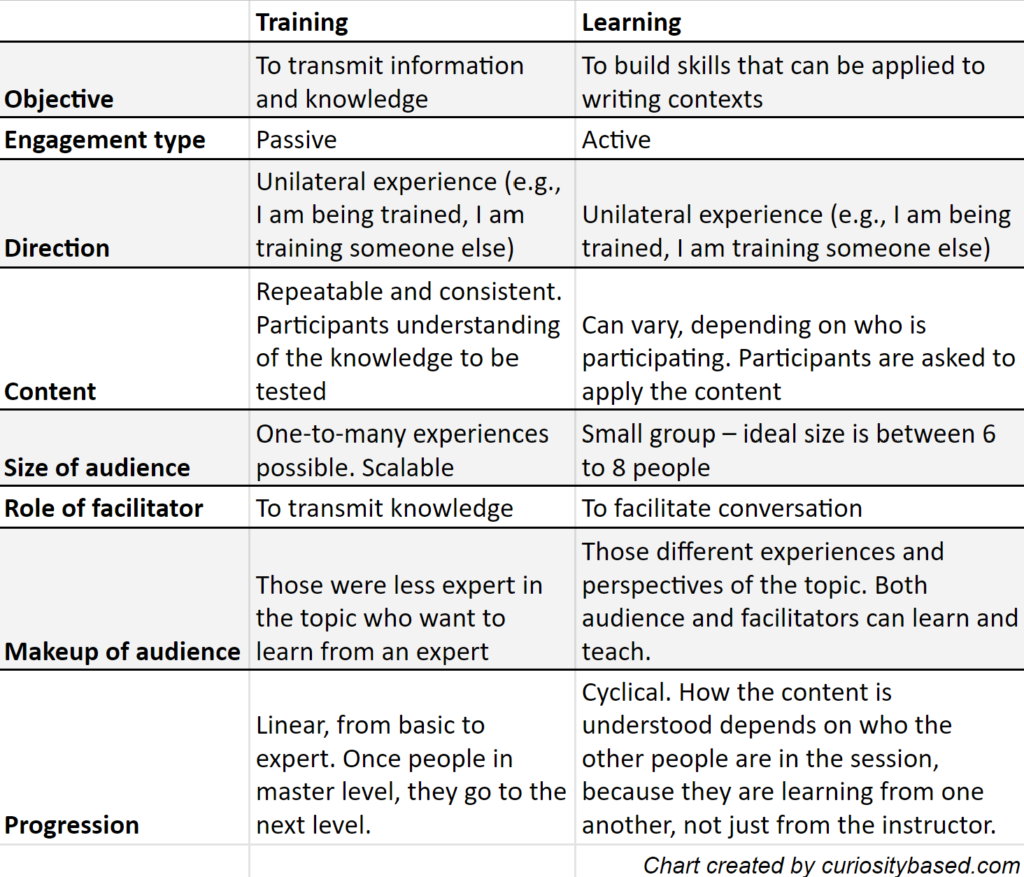
I’m a big advocate for “learning” experiences over “training.” The difference can be summed up with this comment we heard from a participant in a learning experience I held on listening effectively. She said, “I’ve been to a lot of trainings about how to listen, where we just sat there, listening to the instructor tell us how to listen better. This is the first time I’ve spent practicing listening in a training about listening.”
Professional development is dominated by training to the point that if people don’t get a massive list of new vocabulary and worksheets, they don’t think they are learning anything new or valuable.
When I take people through a learning experience, I use the Socratic method, and I ask lots of questions to stimulate critical thinking and invite people to draw out their own learning. I’ve had people leave learning experiences I’ve led saying, “I now have more questions than answers.” That can be incredibly frustrating for some people, and eye opening and empowering for others.
At the end of a training session, If you asked the participants what they learned, the answers should be fairly consistent And they came to be tested on their knowledge. With the learning experience, I ask people to describe a take away. I’m always surprised by how people have different takeaways and I as a facilitator and content creator get to learn something as well. One person described this closing reflection as “naming our own meaning.”
Choosing What’s Right For You
There are times when training is the more appropriate choice and other times when learning is what is needed. These questions are designed to help you determine what you need to give to your team, especially while many of us are working remotely.
- Do you need to deliver the same content to as many people as possible at one time or can you have multiple sessions with smaller groups of people?
- Do you prefer people to something in a particular way or are you open to different ways of achieving the same/similar results?
- Do you have deep trust across your different departments or are you looking to build more trust across silos?
- Are your employees asking you for more content to help them do their work better or for more connection with each other?
- Is your team or company made up of individual contributors or collaborators?
- Do you want your team to have a shared language or a shared culture?
- Are you prioritizing serving external clients or internal clients?
- Are your team members more interested in listening passively or engaging actively?
If you mostly chose the first choice, then training is probably a better option for you. If your answers fell primarily toward the second choice, then you should explore learning experiences.
Prior to the pandemic, when we could be in person with one another, a good training was an efficient way to transmit substantial amounts of content. We took for granted the connection that came from being physically present together. Now, as we work remotely, taking the time to slow down and learn from and alongside one another allows colleagues to connect meaningfully. Before you default to training, explore what learning experiences could do for your team.
This post was based on “Being “trained” isn’t necessarily “learning”, which was originally posted on Dec. 14, 2020.