banner

Daisy Jones & the Six: Lessons on Love, Respect & Learning (Spoilers)

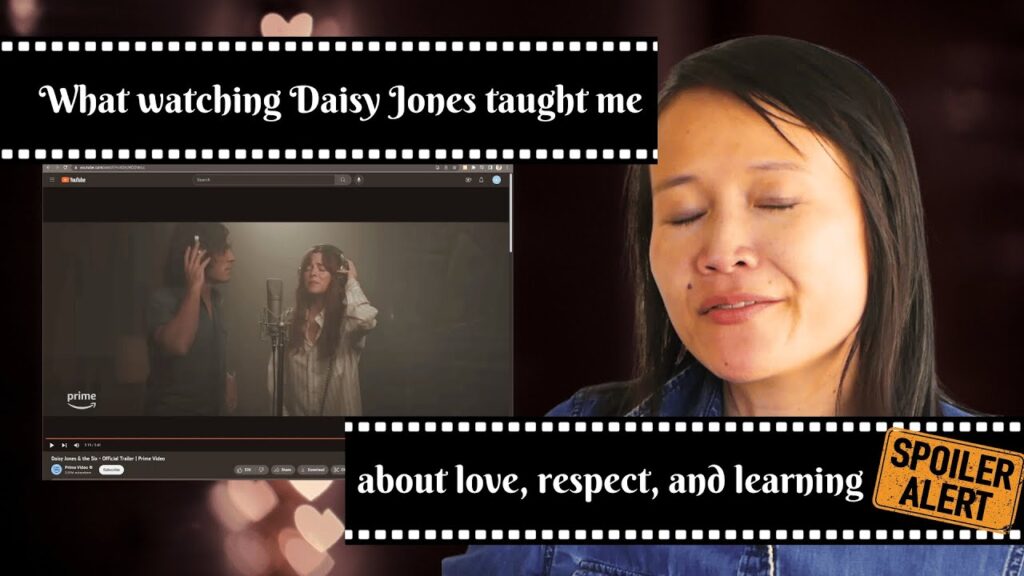
I don’t watch many shows and I don’t own a TV, so I surprised myself with how obsessed I became with Amazon Prime’s new series, “Daisy Jones and the Six.” The show depicts the rise and fall of a fictional rock band that achieved great fame in the 1970s.

I found myself re-watching episodes, searching for interviews with the actors, and even reading the original book by Taylor Jenkins Reid, on which the series is based. I decided to explore why I became so engrossed, embracing curiosity.

Here’s what watching Daisy Jones taught me about love, respect, and learning. Please note that this discussion contains spoilers, including the ending. If you haven’t seen the series yet, you may want to pause here and watch it first.

Lessons on Love

The show demonstrates that people are capable of loving multiple individuals simultaneously. It’s not about loving someone more or less, but rather about loving them differently because they resonate with different aspects of who we are. The central plot revolves around the love triangle between Daisy Jones, Billy Dunn (the two lead singers), and Billy’s wife, Camlia. While some fans may interpret this differently, I firmly believe that Billy loves both women equally, albeit in different ways. They each connect with different parts of his complex self.

Lessons on Respect

To make the best choices for themselves, individuals must possess self-respect. I particularly appreciated the portrayal in the Amazon Prime version compared to the book. In the book, Camilla tells Daisy to stay away, and Daisy complies. However, in the show, Camilla tells Billy that he must choose whether to remain in their relationship or not. This act demonstrates self-respect. Camilla doesn’t approach Daisy with a possessive stance. Similarly, Daisy respects herself by realizing that she can’t simply stay in the band, hoping for a romantic relationship with Billy. She understands that she needs to leave the band, enter rehab, and regain control of her own life. Her decision is not influenced by Camilla’s request, as depicted in the book. Billy also exhibits self-respect by striving to be a faithful partner and father, contrary to his own father’s behavior. He understands the importance of making difficult choices to align with the best version of himself. As they all respect themselves and set boundaries, they are able to pursue their own best lives.

Lessons on Lifelong Learning

The series teaches us that it’s never too late to learn something new, regardless of our age. The actors Sam Clafin and Riley Keough learned how to sing and perform as a band in just a year and a half, and they excel at it! They even became the first fictionalized band to reach number one on the Billboard charts. The behind-the-scenes story of the show’s production has inspired me to contemplate my own potential for learning. It’s impressive that all the actors are singing and playing their instruments, without the use of voiceovers. The music is undeniably catchy.

If you’ve watched the series, I’d love to hear if you agree with any of my observations. Which of these three lessons resonates with you the most? If you found this post helpful, please consider sharing it with a friend or on social media.

17 Signs of Curious People (A Learn-It-All)

I haven’t met anyone who doesn’t want to think of themselves as a curious person and yet their know-it-all attitude suggests otherwise. Here are some signs of a learn-it-all, or those who practice curiosity regularly in their lives.

For three years, I ran a 6-month fellowship program. I noticed some people did really well and other people really struggled and it took me a while to figure out what differentiated the two. And then I landed on curiosity. By the third cohort, we started interviewing for that. Curiosity helps people persevere when times are difficult, it helps them be resourceful when facing a challenge, or to be empathetic to other people, because they want to know. 

There are some people who are so focused on getting to a particular outcome or result that they would be the naysayers and they didn’t wanna move forward. For the longest time, I thought curiosity was a trait. Now I think of it as a practice, because I realize that when you have more people on a team who are practicing curiosity, they can actually uplift the morale of everyone else. And when you have people who just care about the outcomes and not the process, then they can actually take down the morale. Here are some signs of someone who is a learn-it-all:

Here are the 17 signs of a learn-it-all:

  1. Is comfortable with not knowing all the answers, and admitting “I don’t know”
  2. Admits that they are not a perfectionist 
  3. Asks questions to clarify, not to show off how much they know
  4. Listens to understand, not respond
  5. Likes to try new things 
  6. Talks more about “learning” than about “knowing”
  7. Talks about what they want to learn, instead of what they want to accomplish or what the results are going to be
  8. When they talk about mistakes they’ve made, they talk about the lessons they learned, instead of talking about what they would’ve done to avoid those mistakes
  9. Has a diverse group of friends (However you can define “diversity”)
  10. Talks about the people that they learn from
  11. Reads books, listens to podcasts, or pursues hobbies that don’t have anything to do with their job or profession 
  12. Tries to learn things that they know there is a chance they might never excel at it
  13. Listens to different genres of music 
  14. Watches different genres of films 
  15. Reads both fiction and nonfiction 
  16. Looks up things to learn more, not to check if they were right or wrong
  17. Thinks more about the journey than the destination 

Now, you don’t have to have all these signs to be a learn-it-all. I certainly don’t. 

This is just the starter list. I’d love to hear your suggestions as well. I want to add to this list.