banner

How to Grow Your Professional Network in 3 Steps

Building a strong professional network is crucial for career advancement and business growth. In this article, I will discuss two important categories of people to grow your professional network: peer mentors and referral partners

Peer mentors are individuals with specific knowledge or expertise who can coach you, while you have different knowledge or expertise to offer in return. 

Referral partners are valuable for sales roles and entrepreneurship, as they help each other find opportunities and expand their networks.

To increase your peer mentors and referral partners, follow these three steps:

  1. Identify the people you want to connect with:

Consider individuals whom you believe you can add value to, and who can add value to you based on your own definition of “value.” You can connect with people through introductions from friends, engagement on social media, or virtual networking spaces such as breakout rooms. When approached to pitch a service, respond by suggesting a conversation to learn about each other’s offerings and potential customers, offering mutual advice.

  1. Reach out:

This step is critical to expanding your network. If you’re good at starting conversations, make sure to follow up and pursue them actively. If reaching out with a cold call, take action rather than just planning. Use email or LinkedIn to send messages, including the following templates:

Peer mentoring:

“We met through this group/at this event, and I appreciated your insights on (fill in the blank). As you are an expert in (fill in the blank), I was wondering if I could seek your advice. I would be happy to share my expertise on (fill in the blank) and address any questions you may have. If you’re interested, let’s schedule a virtual meeting where we can help each other out.”

Referral partner call:

“While there are many things I do, there are also many things I don’t do. I always strive to be a resource for my clients, even if I’m not the solution provider. Would you be interested in a 30-minute call to learn about each other’s businesses and explore potential client referrals?”

Always include a scheduling tool to facilitate the next steps, as some recipients may immediately schedule the session.

  1. Get what you need out of the call:

Don’t hesitate to be clear about your expectations regarding time and value sharing. If someone agrees to a call focused on sharing leads, they expect this arrangement. Clearly define the agenda for the call. After a brief introduction, divide the remaining time to address each person’s needs. Peer coaching calls can be 30-60 minutes, while referral partner calls can be 20-30 minutes. Stick to the intentions you expressed in your outreach message.

During the call, feel free to ask for what you need without hesitation. Use peer coaching calls for role-playing difficult conversations, getting feedback on presentations, or conducting user tests. Referral partner calls should primarily focus on understanding each other’s businesses and potential client referrals.

By following these steps and maintaining clear expectations, you can make the most out of your connections and build a strong network of peer mentors and referral partners.

Are you inspired to expand your network now?  If this post was helpful, please share it with a friend or post it on social media. You can also check out these professional networking strategies to make any conversation more engaging.

Tips on Deepening Relationships Remotely
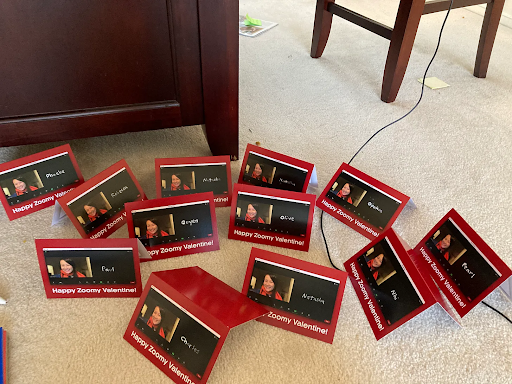
My 2021 Valentine Card concept. To capture the spirit of 2020, the theme was “silver linings.” The front of the card is a Zoom frame and the right square is black. I personalized each card by writing the recipient’s name in with white ink. The inside had the design of a Zoom chat window with a standard message sharing some silver linings I experienced in 2020. Below the fold was space for me to handwrite a personal message. I sent the card in a white envelope lined in silver, to add to the “silver lining” theme.

I get energy from interacting with other people. I organize social gatherings. I love meeting new people. In many ways, I’m a classic extrovert. When the quarantine started, I wondered how I would survive. 

My social schedule went from 4-8 in-person meetings on any given day to none. For the first 5 month, because I lived alone, I didn’t see anyone, not my family, not my boyfriend through June. What surprised me was how some of my more introverted friends went stir crazy from the lack of human interaction and I was actually doing pretty okay. 

I thought I’d be the one feeling super isolated. It has been the opposite. I do acknowledge that my lowest-scoring Love Language is touch, so I don’t actually need to physically be with people to feel connected to them. 

While the rate of making new relationships has dropped a lot, I have deepened existing relationships exponentially.

There are many friends I would only see 1-2x a year who I now talk to regularly on the phone. 

Although I appreciate large gatherings to increase the chances of meeting a stranger who might become a lifelong friend, my favorite form of connecting is 1:1 conversations, which I am still able to have virtually. And because I don’t have to worry about commute time, I’m actually able to connect socially with more people 1:1 on any given day than ever before.

So here are some tips for deepening relationships remotely. The quarantine amplified their impact. 

  1. Text message. I send a text to at least 5 acquaintances/casual friends a week. Send a text to say  “happy birthday” or a “checking in…how are you?” I use Facebook to get reminders of people’s birthdays and updates on their lives. When I see a reminder, I check to see if I have that person’s phone number and if I do, I text message a happy birthday wish or a congratulations because it is so much more personal. It has sometimes led to long text exchange or even phone conversations to catch up. Most of the time, it just reminds people, “Someone is thinking about you.” 
  1. Email update. Once a year, I send out a long email update that I personalize with mail merge. My rule of thumb is if I can’t refer to a specific detail about that person’s life or the last time we interacted, I shouldn’t be emailing them. And to be real in the email, I include the happy and the hard stuff. I will usually include a small request, like check out a free workshop I’m piloting or an essay I just wrote to give me feedback. It’s my way of asking people to be part of my journey. I have gotten detailed responses from people, telling me about their lives.
  1. Phone calls. I have regular weekly,  monthly, and quarterly phone calls with friends now. I often take calls while I’m stretching or walking. I am on video conferencing so much that I love an old fashioned phone call and I know others often appreciate it too. I’ve said to people,  “Hey, want to make this a regular thing?” Many are also ad hoc phone calls. There are some days I can reconnect with 4-7 different friends and acquaintances this way. I have one friend who I only met 2-3 times over two years before the quarantine and now we talk once a month. Another friend refers to our now monthly calls as “therapy.” 
  1. Send cards when people don’t expect them. Most people send their cards out in December. Since I was in high school, I have sent out Valentine cards because most adults don’t get Valentines. I express appreciation for friends who supported me during the previous year. I design each year’s card to recap the theme of the previous year and I’m particularly proud of this year’s concept. I still write at least 3-5 lines of a personal message in each card. Since I started using EE Printing ten years ago, I can send out about a 100 a year, limited by my ability to write personal messages.  These have been great ways to reconnect with people. 

I heard a great interview with Morra Aarons-Mele of Women Online by Guy Raz with more tips. 

This post was based on “Tips on Deepening Relationships Remotely,” which was originally posted on Feb. 21, 2022.