
banner

#7 Harnessing Storytelling and Curiosity in a Remote Culture with Jennifer Strachan

Subscribe Now!

Apple PodcastsSpotifyPodbeanAmazon MusiciHeartRadio

Curiosity at Work: Jennifer Strachan on Storytelling, Organizational Culture, and Remote Work Transformation

In this episode of Curiosity at Work, Dr. Julie Pham is joined by Jennifer Strachan, CEO of inReach, a nonprofit that uses the power of storytelling to reshape cultural narratives. With a 25-year career in public and commercial media, including her experience as an Emmy Award-winning producer, Jennifer shares valuable insights into her journey and the work of inReach.

Embracing Remote Work and Organizational Change

Jennifer discusses how inReach navigated a major organizational shift by embracing a fully remote work model. She explains the challenges and opportunities that come with leading a remote team and fostering curiosity within a diverse group. Her approach emphasizes how curiosity can be a catalyst for transformation in both storytelling and organizational culture.

The Role of Communication and Values in Remote Settings

Jennifer highlights the importance of understanding individual communication styles in remote settings. She underscores how recognizing different styles can improve collaboration and strengthen team dynamics. She also discusses how values play a crucial role in shaping workplace culture, especially in a remote environment. By aligning values with communication practices, inReach has created a positive, inclusive, and productive work culture.

Building Connections through Storytelling and Creativity

One of the most creative ways in which Jennifer fosters connection within her team is by encouraging the sharing of personal stories and images. She believes that storytelling is not just for external audiences but is also a powerful tool for building internal relationships. These creative practices help build joy and strengthen bonds, even in a remote work environment.

How Curiosity Drives Organizational Culture and Transformation

Jennifer’s leadership philosophy is centered around curiosity as a transformative force. She believes that curiosity fuels innovation and helps organizations adapt to change. In this episode, Jennifer explains how curiosity drives both the storytelling work of inReach and the evolution of its internal culture. Tune in to learn how curiosity can lead to positive change and drive growth in nonprofit organizations.

Connect with Dr. Julie Pham:

Connect withJennifer Strachan:

Produced by TitanMediaWorx.com

#CuriosityAtWork #Storytelling #RemoteWork #Leadership #OrganizationalCulture #Communication

Ways to Increase Mattering at Work

People want to feel valued and know that they matter at work. For employers, managers, and leaders, here are eight organizational strategies of ways to increase mattering at work, to boost retention and job satisfaction. Even if you’re not a manager, you can contribute to a positive work environment with these tips.

Here are eight strategies to increase mattering at work

  1. Ask People What They Need to Succeed
    Find out what resources or support they need to do their best work.
  2. Offer Support Beyond Basic Requirements
    Take time to help colleagues with their tasks, showing that you care about their success.
  3. Invest in Skill Development and Growth
    Provide opportunities for training and professional development.
  4. Inquire About Future Aspirations
    Ask employees what they want to do next and explore opportunities within the organization.
  5. Reference Their Input
    Show that you’ve been paying attention by referencing things they’ve said or written.
  6. Notice Their Absence
    Acknowledge when they’re not present in meetings where they were expected. A simple, “I was hoping to see you there,” shows you care.
  7. Compliment Their Approach
    Recognize not just the outcome but the way they completed their work.
  8. Evaluate and Redistribute Work Based on Energy
    Ask employees which tasks energize them and which drain them. Redistribute tasks to maximize engagement and productivity.

For more on increasing mattering at work and it’s powerful impact, check out my video.

If you found this video helpful, please like and share it.

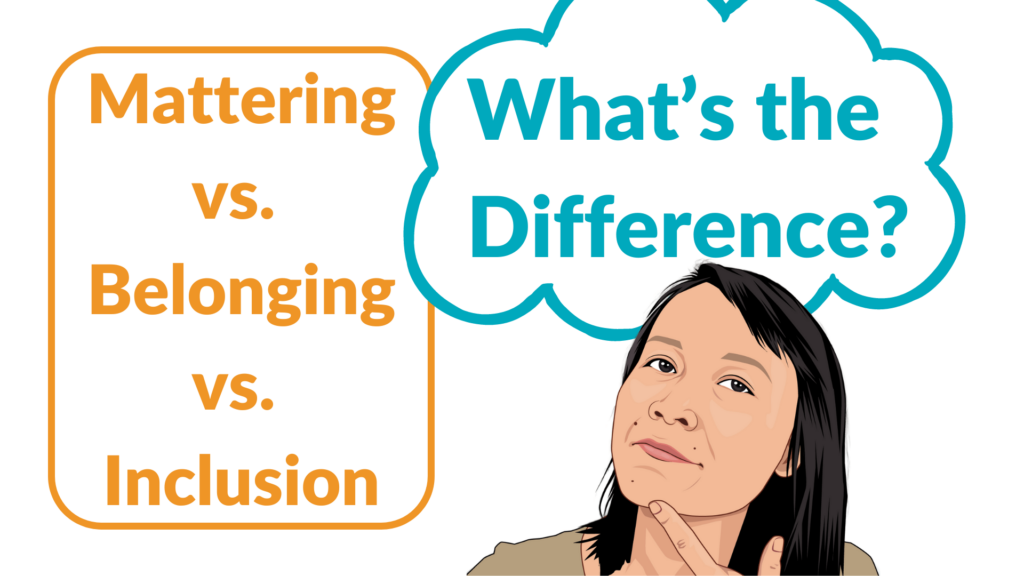
Mattering vs. Belonging vs. Inclusion: What’s the Difference?
Mattering vs. Belonging vs. Inclusion: What’s the Difference?

People often use the terms mattering, belonging, and inclusion interchangeably when discussing organizational culture. While they’re related, they each have distinct meanings. Here’s a breakdown of each term, with a focus on the newer concept of mattering.

Understanding Inclusion

Inclusion refers to the policies and actions employers use to help employees feel accepted at work. Examples include acknowledging and celebrating cultural holidays like Lunar New Year, Juneteenth, or Cinco de Mayo. These policies create an environment where diverse individuals feel they are a valued part of the organization.

Understanding Belonging

Belonging is the feeling of acceptance that results from successful inclusion policies. When employees feel they belong, they experience a sense of connection and acceptance within the workplace.

Understanding Mattering

Mattering occurs when employees feel their work is valued and that they would be missed if they weren’t there. According to Dr. Zach Mercurio’s research, mattering has three primary drivers:

  1. Feeling Noticed
    The employee feels seen and heard within the organization.
  2. Feeling Affirmed
    The employee understands that their unique strengths make a significant difference.
  3. Feeling Needed
    The employee believes they are indispensable to the organization’s mission and purpose.

The Interplay Between Inclusion, Belonging, and Mattering

While inclusion efforts are essential, they don’t automatically guarantee belonging or mattering. Employees must desire to belong and feel that their strengths align with the organization’s needs. For example, if an organization needs data collection, but an employee excels in data visualization, there may be a mismatch, preventing the employee from feeling valued.

Aligning for Success

Employers and employees must work together to create a sense of mattering and belonging. Both parties need to ensure that the employee’s unique strengths align with the organization’s needs.

I hope this post clarifies these important terms and their roles in enhancing workplace well-being, employee engagement, and job satisfaction. If you found this post useful, please like and share it.