I fully appreciated how the power of constraints and limitations can unlock creativity when I returned to Seattle to run my family’s newspaper in 2008, the start of the global recession and decline of the newspaper industry. I was forced to be extremely scrappy and entrepreneurial as my parents and I tried to survive these unfortunate circumstances. That experience, though, informed how I approached my work later on.
Here are 6 tips to help you think about constraints and limitations differently:
1. Accept that you have constraints and limitations so you can unlock creativity.
We might be tempted to dwell on what we don’t have or what we should have. It’s OK to feel upset. It is then that we move on and get to acceptance; that is where we can start the work.
2. Focus on what you do have, not on what you don’t have.
While there are many things that we don’t have, they’re actually many things that we still have. My favorite story around this is with impressionist painters. A group of painters were painting together, and they realized they didn’t have any more black paint, so they started using violet. Then violet became the new black, the darkest shade. Without the color black, the impressionist paintings look so much more light. Here, they focus on what they did have, which was the color violet.
3. Focus on what you can try and experiment with.
Not having things can also make us experiment more. When we hold our learning experiences (what we call our workshops), we really like to have breakout groups so people can talk with one another. With some of our CuriosityBased clients, they don’t want any interaction with one another so I had to create a sense of interactivity without being able to rely on one of my go-to. We started to experiment with different kinds of polling to quickly get anonymous information from people. We would then show the results of those polls and have the people react to them. This constraint actually led us to improve the polling in our regular learning experiences that do have breakout groups. This limitation helped us improve overall.
4. Be clear about what you actually need to accomplish the work.
Sometimes we’re so used to things we think we need to have that we forget that we actually don’t really need them in order to do the work. For me, for example, I usually have access to a screen to project a PowerPoint slide deck when I am facilitating in-person sessions. So when I was asked to facilitate an outdoor session in a park, I couldn’t use my usual tech. Instead, we printed follow-along packets for people to consult. Turns out I didn’t need a projector after all.
5. Trade products and services to get what you need.
When I worked at the newspaper, we had a lot of advertisers who had fallen behind on their bills, and also people who wanted to advertise and they just didn’t have the cash. We ended up doing a lot of bartering services like restaurant gift cards and printing services so we could each get what we needed.
6. Ask for help so you can get more resources.
I used to lead volunteer teams in building projects with no resources in a very short time frame. Some teams asked for donations, but I remember one team in particular wanted to organize an event and they ended up getting cupcakes donated, a free space, and volunteers to help. Once they expressed a need for help, people offered more than they had hoped for.
When we frame constraints as a way to force us to do things differently, that is when we discover our inner creativity. Which of these reframes resonates with you? I’d love for you to share your thoughts in the comments section. If this was helpful, please share it with a friend or post it on social media.
So much of what I learned about being the boss of my own life was from watching my parents, who founded the first privately-owned Vietnamese newspaper in the Pacific Northwest.
Here are 5 lessons I learned that can help you become the boss of your own life
Lesson 1: Love doing the work as much, if not more, than the product of the work itself.
We spend so much of our time doing the work. So, it’s really important that you enjoy the process and not just the outcome. I hear from some people that they are so relieved when the work is done and they dread starting to work again. That’s a bad sign. I am certain my father preferred the days preparing the newspaper more than the day the newspaper came out because by then, he was already thinking of the next issue. As for me, I started my own business so I could focus my energy on writing. I love the process of turning my original content into learning experiences.
Lesson 2: Choose who you work with, don’t do things alone.
This is easier to do when you are an entrepreneur versus when you are an employee. Working with people you collaborate well with can make a huge difference in terms of your effectiveness and feeling a sense of control over your life. For those of you who are entrepreneurs, remember, you get to choose. If you’re a manager and you have team members who you don’t think are a good fit, don’t feel guilty about letting them go. Even when you are an employee, be intentional about who you collaborate with. From the get-go, I knew I would work with a team (even if that meant paying them out of my own pocket). I knew that working with team members would enrich whatever I do. Even if you’re a solopreneur, you can choose your partners who help you serve your clients. Having collaborators keeps me accountable. I know we are working together on a shared purpose vs if I was working alone.
Lesson 3: With ups come downs, so be prepared to absorb the bumps financially.
A bad economic downturn can make you feel you’re really out of control. One way to prepare for possible downturns is by saving money. My experience of running the newspaper with my family during the 2008-2010 recession forever instilled in me a frugality that I carried even when I was an employee at well-resourced organizations. This enabled me to have the savings that gave me the financial freedom to invest in my own business. Save during the good times so you can weather the bad times. That approach helped me tolerate my significant losses in my second year of business. It also allows me to remain conservative despite significant gains as I enter my third year.
Lesson 4: Appreciate the value of freedom, and recognize the emotional cost of being micromanaged.
When I told my father I was going to leave my executive job at a remarkable nonprofit to start my own company in the middle of a pandemic, I was worried he would disapprove. Instead, he said, “I’m so happy for you. By having your own business, you are in control and you will have freedom.” I feel that now that I have my own company. Working for micromanagers in the past took a costly emotional toll on my confidence and sense of self-worth. So if you have a bad client, remember you can choose not to take their money. When you’re an employee, work for those who trust you and give you the freedom to do your job.
Lesson 5: Ask for help, so you can be in control of what kind of help you get.
At the start of my business, I had some people offer to help me by introducing me to free work for their team. That was their idea of helping me, but it wasn’t what I needed. I learned to be very specific about the kind of referrals to potential clients I’d like to get and I even provided an introduction text to help people help me. When you’re the one asking, you can be more specific. Otherwise, you may just take what people offer to you instead of what you need.
Which of these lessons resonates with you the most to help you become the boss of your own life? I’d love for you to share your thoughts in the comments section. If this was helpful, please share it with a friend or post it on social media.
6 Steps to Identify How You Feel Your Friends Should Treat You
We may have friends who don’t always treat us well, or might even hurt us, and we also have friends who treat us really well. We may instinctively know what we like or have an idea of how we feel friends should treat us, and yet most of us haven’t ever articulated it. Before we can ask people to treat us differently, we have to be really clear about how we want to be treated.
Here are six steps to help you identify how you feel your friends should treat you.
Ask yourself who among your friends treat you well. I am fortunate I have a really long list of friends who have been amazingly supportive over the years.
Write a list of examples of what these friends do for you. As I looked at the list of names, I thought about the specific things people did to support me. It could be text messaging me to check in, remembering my birthday, posting a photo of my book in an interesting place, etc.
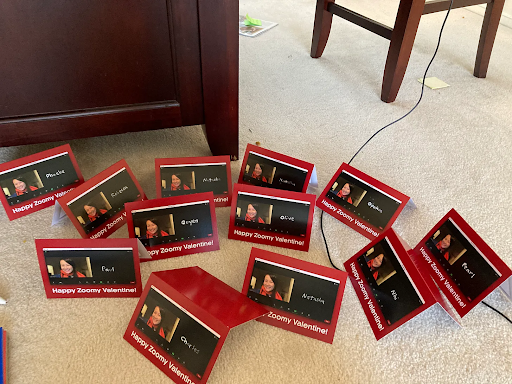
Analyze the list for themes and patterns and consolidate it to make the Iist shorter and more general. For example, you might have, “listens to me when I was feeling sad about losing my job” for one friend and for another friend, you wrote, “Listens to me when I was having health issues.” So the general theme here is someone who listens to you. For me, I have been really moved by all the acts of kindness from my friends. Every year, I design a different valentine card. This year, I decided to write out a list of all of these acts of kindness and highlight that particular ones people did. You can read my list here.
Write a list of the friends who treat you badly. Oh, fortunately, this list is a lot shorter. People always listen. I’ve been in my life for a really long time and it’s more of legacy friendships out of habit.
Write a list of examples of what these friends do that hurt you. For me, they have unrealistic expectations of me.
Analyze this list. Do you see something on the list that is the opposite of how you would like to be treated? Perhaps you should add that to your list of how you want to be treated. For example, you have a friend who constantly interrupts you. You can write, “Doesn’t interrupt me when I’m talking.” For those of you who are familiar with the 7 Forms of Respect framework, you can even categorize how you want to be treated by the forms of respect.
It’s so easy to say, “I want my friends to treat me better”, but “better” can mean different things to different people. We have to be specific about what we mean so there can be change. For example, one person might like it when other people buy them meals and another person might not like that because it feels condescending, as if their friends think they can’t afford to pay for their own meal.
Also, let those friends who treat you well know you appreciate how they treat you and be specific with your examples. And next time you interact with the friends who hurt you, specify how you would like to be treated, referring to the list of examples from friends who treat you well.
If you need help specifying how you would like to be treated and respected, check out our free crash course, a 20-minute guide to asking for the respect you want.
“Can my empathy for others develop as my own life changes?”
Empathy is about being able to share what others feel. Sympathy is understanding someone else is suffering.
It’s easier to notice when other people lack empathy than to acknowledge that we may have less empathy than we think. Our ability to empathize can actually change as we get older. We can have less of it.
Something that feels vulnerable to many people is asking for help. Unless we have to ask others for help, we usually won’t. The more power, wealth, and seniority we gain, the more we are shielded from having to ask. Over time, our ability to empathize with those who do have to ask for help fades. Instead of empathizing, we sympathize.
There are many people in this world who need help and who have to ask for it. When we ask others for help, we can deepen our ability to empathize with those who need help.
I often hear from friends wealthy friends who grew up poor that they worry about their children’s ability to empathize with those who don’t have as much. If you are in this predicament, you can teach your children how to ask for help. Teaching them how to help those who have less than them will teach them sympathy, not empathy.
Having empathy matters. Many studies show empathetic leaders are more effective at increasing trust, collaboration, and productivity.
I share a three-step exercise I created to help people call forward experiences that will enable us to develop more empathy, at least around how vulnerable it can feel to ask for help out of need.
1) Think of what you’re going to ask for help.
The first step is to think of something you personally need. It could be something that would improve your life that you don’t have the resources for or that would be a financial hardship or great inconvenience. It could be asking for someone to take you to the doctor or lend you their vacation home or watch your pet.
This is not about asking for help on behalf of another individual or organization, like fundraising for a nonprofit. Also, this does not include sales transactions. Asking someone to compensate you for something that they will get value from is not the same as you asking for their help.
You might be thinking “There’s nothing I want that I can’t get on my own” or “I don’t want anything that I can’t afford.” Then perhaps your ask is a “nice-to-have”, not a “must-have”.
Until you can think of something, you won’t be able to empathize with people who ask for help when they don’t want to.
2) Think of who you’re going to ask
Could fulfill your request directly, by themselves
Might say no
May change their opinion of you after you ask, whether good or bad
Is not in any way obligated or incentivized to say yes
Don’t consider people who you think are likely to say “yes”. People who have said “yes” in the past or who offered to help you also don’t count. Don’t include people are financially incentivized or who might feel obligated to say yes to you.
3) Make the ask
The third step is to make the ask. Once you do that, you can draw from this experience as a source of empathy.
I have to remind myself to practice this exercise too. I swallowed my pride recently when got invited to a VIP dinner. While I suspected it would be expensive, I still got sticker shock when I received the invoice. I was asked to make another contribution. I struggled over whether I should say something. Remembering this exercise, I decided to admit to the host, who I’ve never met, that I can’t afford the additional gift and asked her to waive the request. She did.
It doesn’t matter what you’re asking for as long as you personally feel vulnerable. We all have different thresholds for what threatens to wound our pride.
When we are able to acknowledge what help we need for ourselves, we’ll develop empathy and not just sympathize with others who ask for help.
Asking for help to build our empathy can’t be a theoretical exercise. You actually have to do it so that you can feel it.
How to Help People Get What They Need: Become a Resource Connector
Many people, including myself, want to be helpful, although oftentimes we cannot help others directly because we don’t have the exact resources they need. The second best thing is to help connect people to the resources they need with those who have the resources to give.
Years ago, I went to a conference where the keynote speaker talked about how Oprah doesn’t promote herself, she promotes other people. She’s constantly uplifting and recommending other people. And in that way, she is a connector. That lesson has stuck with me. I’ve been able to build an extensive network in Seattle. It’s because I’m always just trying to connect people to the resources they need and to the people they should get to know.
I realize that I don’t need to be the center and have all the answers and provide all the resources myself if I can just be someone who helps connect people. When I ran a cross-sector fellowship, we focused on helping people learn how to be resource connectors. We asked this question: “What is something that you want to give? What is something that you need?” What people shared was very powerful.
You can be a resource connector.
It requires seeing everyone as having resources and also having needs.
It doesn’t matter how little money or little time you think someone has. Everyone has something to offer. And everyone has needs. Sometimes what they need and what they have to offer are the same thing.
What you’re really doing is connecting the dots. It requires a lot of asking questions and listening to people.
Here are the 6 steps to becoming a resource connector:
Ask people if they have any particular resource that they want to share with others. You can ask, “Is there anything you want me to spread the word about or any resource you have to share?” Oftentimes the thing they’re asking for help from is the same thing that they are offering. For example, they may need help spreading the word about a special program that they lead. They’re also offering the resource of their program. So you may not even need to ask them if they have something that they want to share because they may have answered it within their ask for help. Sometimes people don’t like to ask for help, so they will just frame it as something that they are offering. I remember talking to a coding school founder who wanted to help people with their career transitions into tech.
Ask those same people, “Is there anything I can help you with? I might not be able to help you directly, though I might know someone who can.” Sometimes they only want to offer help and yet their offer of help is actually an ask. In this case, offering to teach coding is also an ask for help with recruiting students.
See if there’s anything that they need that is related to something someone else offered. As you talk to other people, look for opportunities to connect resources with the people who might be good candidates for them. For example, someone may say that they are looking for a way to learn how to code and you just met someone who runs a coding program and is looking for students.
Before you make the connection, reaffirm with the person who is offering the resource that they are still offering it. So, I asked the coding school founder, “Are you still looking for students?” She was.
Make the connection. It can be as simple as an email.
Bonus: Follow-up and check on if a connection was made. Sometimes I find out that one party never replied and I might nudge the to reply. At the very least, I know who is good to follow through and who isn’t and who I should and shouldn’t make connections for in the future.
Your efforts will generate goodwill and perpetuate a spirit of generosity. When people are helped, they will want to help others. And even if it doesn’t turn out exactly as people hoped, they were further along than before.
For example, I talked to a friend, “Alex”, who is looking for a job as a project manager at a biotech and then I asked another friend who founded biotech if he would be willing to chat with this friend. It turns out that he was looking for a project manager and he interviewed my friend for the role. Although it didn’t work out, my friend got a lot further than he would’ve before.
I haven’t met anyone who doesn’t want to think of themselves as a curious person and yet their know-it-all attitude suggests otherwise. Here are some signs of a learn-it-all, or those who practice curiosity regularly in their lives.
For three years, I ran a 6-month fellowship program. I noticed some people did really well and other people really struggled and it took me a while to figure out what differentiated the two. And then I landed on curiosity. By the third cohort, we started interviewing for that. Curiosity helps people persevere when times are difficult, it helps them be resourceful when facing a challenge, or to be empathetic to other people, because they want to know.
There are some people who are so focused on getting to a particular outcome or result that they would be the naysayers and they didn’t wanna move forward. For the longest time, I thought curiosity was a trait. Now I think of it as a practice, because I realize that when you have more people on a team who are practicing curiosity, they can actually uplift the morale of everyone else. And when you have people who just care about the outcomes and not the process, then they can actually take down the morale. Here are some signs of someone who is a learn-it-all:
Here are the 17 signs of a learn-it-all:
Is comfortable with not knowing all the answers, and admitting “I don’t know”
Admits that they are not a perfectionist
Asks questions to clarify, not to show off how much they know
Listens to understand, not respond
Likes to try new things
Talks more about “learning” than about “knowing”
Talks about what they want to learn, instead of what they want to accomplish or what the results are going to be
When they talk about mistakes they’ve made, they talk about the lessons they learned, instead of talking about what they would’ve done to avoid those mistakes
Has a diverse group of friends (However you can define “diversity”)
Talks about the people that they learn from
Reads books, listens to podcasts, or pursues hobbies that don’t have anything to do with their job or profession
Tries to learn things that they know there is a chance they might never excel at it
Listens to different genres of music
Watches different genres of films
Reads both fiction and nonfiction
Looks up things to learn more, not to check if they were right or wrong
Thinks more about the journey than the destination
Now, you don’t have to have all these signs to be a learn-it-all. I certainly don’t.
This is just the starter list. I’d love to hear your suggestions as well. I want to add to this list.
I’m a big believer in volunteering as a way to build your skills and eventually get your dream job. I got my real-life MBA when I was running my family’s newspaper. Aside from that job, I did a lot of volunteering on various boards that taught me how to sell, market, and publicize. I remember when I interviewed for my first corporate job, which was in marketing, I was able to point to leading the Seattle chapter of the National Association of Asian American Professionals to place first in the nation in marketing.
There are many small nonprofit boards who need board members or committees that need volunteers. While this is skills-based volunteering, you don’t necessarily need the skills to do the work in the beginning. You just need to make the time and commitment to learn the skills.
It’s like getting an unpaid internship when you’re already a professional or you’ve already graduated. But not all volunteer opportunities are created equally. And just because a nonprofit needs you, they might not be a good fit for what you need.
Here are 6 questions to ask to help you determine if this is a good opportunity or not:
1. Is this organization okay with me “learning on the job”?
Some organizations think it’s too risky to have a volunteer do skills based work and others see it as a way to build capacity by having a pipeline of inexperienced volunteers they can train. Large and/or well staffed nonprofits might not take on volunteers. There are many small nonprofits that don’t have staff who will gladly take on skilled volunteers. I find that an ideal nonprofit to volunteer at is either a small one that has no staff, an organization that has been around for a while, or a bigger one that has some staff and a committed board.
2. Are the people who I’m going to volunteer with willing to teach me and mentor me in exchange for my time?
Are the people who head the committee and board actually willing to mentor you? If they are too busy or they themselves are actually not skilled to teach you, then it’s not a good fit. I know someone who is going to become the treasurer of her HOA board of her condo building, even though she has no experience in finance. The outgoing treasurer is going to teach her how to read financial reports. This is a skill that usually people have to take classes to learn. When I was on the Celebrate Asia Seattle Symphony committee, I learned a lot about how to sell from founder, Yoshi Minegishi, who had been an executive at IBM. When I was later on marketing chair of NAAAP, where there was no one to teach me and no staff, I reached out to past board members who could guide me. The benefit to marketing was that there was an already established audience. I didn’t have to test those skills on my own. Even if you don’t have a mentor, if you have a platform, that’s still okay.
3. Are the other volunteers also committed?
For you to be able to learn, you have to be able to work with other people who are committed. Ask to sit in on a board meeting or a committee meeting to see how engaged the other volunteers are. Once I was invited to join a prestigious board of directors, and I went to a meeting and I saw how unprepared the board members were. I realize they were committed and that it wasn’t going to be a productive board if we were going to have to reset expectations at every board meeting, regardless of how prestigious the board was. So it’s really important that you find out if the other volunteers are committed. Otherwise, it’s not gonna be worth your time. Just ask to sit in on a board meeting or committee meeting and you’ll see.
4. Does the organization’s volunteer needs align with my interests?
Skills-based volunteering can be a lot more time-consuming and frustrating, especially if you’re learning something new, than volunteering for just a few hours for a food drive or planting a garden. For example, you may want to learn how to sell and they need help on their fundraising committee. You can learn from the head of the fundraising committee on how to sell. If they just need someone to plan their event, and you have no interest in planning an event, then there is a mismatch. Or if you are an IT expert and the organization may need help with IT, and you want to do something different during your volunteer time, then there’s a mismatch. If you’re going to use volunteering to help you get your dream job by building skills, you have to be a bit selfish about what your learning goals are. They may need something that you don’t want to do. And it’s OK for you to say that. I know people who do bookkeeping for their day job and they don’t want to do it and they volunteer because they want to learn something new. And then there are other people who want to volunteer what they are already good at.
5. Is the organization responsive in its communications?
Some organizations say they need help, but they are so swamped, they can’t even respond to volunteers. If you find that you are chasing them, then that’s a bad sign that they don’t have the capacity to actually work with volunteers. If they’re super responsive, that means they are organized and you don’t have to spend a lot of time chasing them down so that you can give your time. Many nonprofits are so small that they don’t even have someone to coordinate their volunteers. So if you email and you’re not getting a response within two weeks, that’s a bad sign. Yes, people are busy. But you can still be busy and say, “I’ll get back to you.” You don’t want to be chasing down opportunities to do free work.
6. Is there a clearly defined period of time that I will volunteer for?
Think of this volunteer gig like school. Find out how long you will be studying for. Is it going to be two years? Three years? Or do you work on a special project that will last just weeks or months? Maybe you’ll end up taking on multiple special projects and at the end of each project, you will decide to renew so you can learn more skills. Just have a clear idea of how long the term lasts so that you understand what you’re getting yourself into when you volunteer and you know that you are able to follow through with this commitment. We all want to give our time and what I see a lot of people saying they want to volunteer and then they flake. If you do decide to do skilled volunteering, know that people are counting on you and need you to get that work done and you should only commit to what you think you can follow through on. So get clear on how long the projects going to last or how long the commitment will be and ask yourself if you can actually give that time.
Bonus
Notice a question I haven’t posed is, “Am I going to support a cause that I care about personally?” It’s a bonus if you can find an organization that has a cause that you care about personally. However, if you are volunteering so that you can also learn new skills, I think it’s much more important for you to get yes for other questions.
Volunteering is a really great way to build skills if you’re unemployed. Also, sometimes people are wary of hiring those who haven’t been working for a while. Volunteering shows that you’ve been doing something with your time, not just idling. Aside from all the skill building, you’re also building relationships and networks. I have hired people who volunteered with me. And I’ve been hired by those I volunteered with. It’s because they were able to actually see my work product. I gave them a lot more confidence in hiring me.
9 Ways to Support the Entrepreneurs in Your Life Without Being a Customer
Your friend started a business and you want to support them but it doesn’t make sense to buy their product or service. As an entrepreneur, as a family of entrepreneurs who served entrepreneurs, entrepreneurship is hard. Here are easy, free ways to support the entrepreneurs in your life.
Follow their company’s social media channels
Subscribe to their marketing newsletter
Like or Share something they posted about their business on social media
Offer to be a sounding board for their ideas
Connect them to people who might be able to give them valuable advice
Connect them to people who might be potential clients
Ask about their business, the way you would ask about their family
Understand that they may have to prioritize their business—the way you’d be sympathetic to parents with their kids
Understand that their work is personal, that the boundary between work and life for entrepreneurs is thin and sometimes nonexistent
In my blog post about 6 Tips on How to Get a Job You Love, I mentioned writing a proposal to pitch yourself as a candidate for a job, even one that doesn’t exist yet.
Taking the time to write this proposal will also force you to articulate your pitch why you want this job. As you go through the exercise, you may realize that you don’t want it. Or you may realize that you’re still super excited about it.
Every time I’ve written such a proposal, people have been impressed by my ability to communicate, process large amounts of information, and synthesize what needs to be done. I’ve also been on the hiring end where I’ve gotten a proposal and it signaled to me how committed the candidate was to the role.
Ideally, you should write the proposal after you’ve had at least an informational interview, and perhaps even the full interview loop.
Here are the 6 elements of a proposal:
Why do you want to be at that company or in a new role?
Define clearly why you want to be there. Reference specific aspects of the company or of that role that appeal to you. The more detailed you can be, the more believable you will be.
Why do your skill sets and experience make you a good fit for the company or for a different role in the company
Help the hiring manager understand why you would be a good fit, which is different from you being a strong candidate. Being a good fit means that you understand what this role and company needs and you fulfill those needs. You could be really skilled, but not a good fit for their needs. When you describe your experiences, that’s what sets you apart from other candidates. This also helps them understand that you understand what they need.
What you see as the company’s strengths, needs, and opportunities
It might feel uncomfortable for you to give an analysis of both the good and the bad, and yet it shows that you are a critical thinker and listener. You were able to digest what they shared with you and to show a vision of what’s possible. You can literally do this as a SWOT analysis.
What you would do to address the needs, weaknesses, and opportunities
And after you write the SWOT analysis, then talk about what you would do to reinforce their strengths, improve the areas where they are weak, pursue their opportunities, and address their threats.
Create a sample timeline of your plan to add value
Write out a plan of how you would go about fulfilling this role in the first three, six, or nine months on the job. You don’t want to go too far in the future because there could be a lot of things that change. Make it just long enough so that you have done enough to make progress and know what to do next. Keep in mind that you won’t necessarily exit on this plan, but that it shows your ability to prioritize and plan and that you were action-oriented.
Compensation
Think about what you would want to be compensated for this role. Do your research. It might be uncomfortable for you to write it out. But it might even be more uncomfortable for you to say it to them. Think about other benefits and parks that are important to you and you can put them in here.
Whenever I’ve written these proposals, they’ve been at least 3.5 to 5 pages long. Remember, you are writing this proposal for both you and the employer, not just the employer.
Why Increasing Rejection Can Be Good For Your Business
As a business owner, hearing “no” can be painful and yet necessary. I actually think that it can be helpful for business owners to hear “no”. Here are three scenarios in which it’s actually good to hear “no”.
No to my sales pitch
If I’m not getting enough “no’s”, then I’m not pitching enough. I did an analysis of my close rate, and I realized I was getting an 80% win rate, which means eight out of 10 people who I asked said “yes” to my request. I realized that is way too high. It means that I’m actually not asking enough people. I was playing it safe.
What is your “win” rate? How many people say “yes” to you versus how many people say “no”? I am aiming to increase the number of people I ask, which will inevitably lower my win rate, but I’m okay with that because I’m expanding my overall potential to gain new business.
No to my price
If some people aren’t telling me that I’m too expensive, then I’m probably not charging enough. I have to be okay with some people not being able to afford my services, just like I’m okay with the services that I can’t afford, so I go with other options.
This also requires you to know what is your bottom line price that you need to make for you to feel valued and compensated. If you’re willing to lower your price, are you going to feel resentful afterward because you did so? Once I said no to a good project, but they changed their scope of work, and it would’ve been much more expensive. They were saying no to my price, and I was okay with not changing my price to accommodate their needs.
No to your method or idea
Not hearing “no” enough means that your content is too generic. Getting “no” means that you are not trying to please everyone and you can focus on what makes you special.
There is a popular sales book called Getting to Yes, about how you overcome objections in sales pitches, and negotiations. I actually think that it can be helpful for business owners to hear “no” and be grateful about it rather than being super pushy.
When I started out my business, I tried to get as many “yeses” as possible. Saying “yes” in the beginning could help us figure out what we’re doing. I asked “who is willing to pay me something?”, because something is better than nothing. As my business progressed, and I got more focus, I realized I couldn’t say yes to everything because it would mean taking focus away from the work that I started the business for in the first place. So, don’t be afraid of getting no. We don’t always have to try to get to yes. This recently happened to me when a prospective client said they were “too advanced” and CuriosityBased workshops weren’t helpful to those who were “further along in their equity journey.” They’re spot on. Their “no” reflected how they wanted training workshops, which takes participants through a linear progression of different levels of mastery.
CuriosityBased designs experiences to enable people to have vulnerable conversations so they can learn from one another instead of from a single instructor. People have taken the same CuriosityBased workshop over and over again with different people and still learn something new each time. The idea that people can be “being further along” conflicts with my philosophy on learning. (You can read more here). Understanding this potential client’s “no” reminds me it’s okay not to compromise or change myself to get to a yes.
When I hear, no, it makes me think, what am I willing to do to get yes? What are they telling me?
I’m not saying you should aim to have 100% “no”. When you hear “no” though, it means you’re pushing yourself out of your comfort zone, which is important for you to focus and grow your business.
Managing expectations is a never-ending exercise in clearly articulating our needs, wants, and hopes. It requires activating all three elements of practicing curiosity: self- awareness, relationship building, and communication.
Here’s what I learned to help me navigate the dynamics of managing expectations that I’ve applied to both my personal and professional life. Here are two ways to manage expectations with others so that they’re not surprised or disappointed with you.
Explicitly describe what people can expect from you
I have to constantly remind myself that people can’t read my mind and I have to be more explicit. In regard to their own expectations, some people think in terms of what they will gain and benefit. For my clients, I describe what they will get with specific examples. For my team, I try to anticipate their questions and concerns. This is especially important now as people worry about layoffs. For my friends, I let them know what kind of support I can provide.
Explicitly describe what people can’t expect
Other people think in terms of what they might lose or won’t get, so I also list what I won’t be doing and what they will not get so that I can manage their expectations. For example, I often tell people my 7 Forms of Respect framework will NOT teach them how to be respectful, that it’s not like 7 Habits of Highly Effective People. For my team, I’ve made it clear that until we become consistently profitable, I can’t increase hours or provide more benefits. For my friends, I let them know when I can’t provide support in the ways they asked of me.
When you manage others’ expectations, they’ll manage yours. People will often meet your level of transparency.
Last year, I was clear about expenses outpacing revenue. I told my team that I understand they have to consider their individual financial needs because I don’t know when I can provide higher salaries. I just ask them to keep me updated if they do search for work elsewhere. When a team member left for a great career opportunity, I was not surprised. My expectations were managed.
Managing expectations is a never-ending exercise in clearly articulating our needs, wants, and hopes. It requires activating all three elements of practicing curiosity: self- awareness, relationship building, and communication.
Here’s what I learned to help me navigate the dynamics of managing expectations that I’ve applied to both my personal and professional life. Here are four tips to manage your own expectations of yourself:
Differentiate between expectations and hope
It’s easy to let expectations slide into hopes, which often don’t have any basis in reality. I realized expectations should be based on my previous experiences to determine what is realistic and possible. For example, I was a bit too optimistic in my second year in business. I was hopeful. I didn’t have any evidence that supported my expectations, meaning they were really just hopes.
Don’t compare myself to others in creating expectations for myself
If I only look at those who I think have more than me, I will always feel I don’t have enough. So, I can’t compare. This is a hard one to admit that I do. I constantly have to remind myself not to compare. I have close friends who are also authors of wildly successful books. As a self-published author without a long track record of prestigious publications or public speaking, I can’t apply the same expectations of success to myself.
Continue to do things I love even if they don’t meet my expectations
There are so many things I love doing, such as writing essays like this, that don’t meet my expectations of desired outcomes. I often remind myself that I don’t write because I expect a lot of views; I write to have an impact, even if that impact is limited to a few readers. Think about what things you love to do and that you would do no matter what, even if they don’t live up to your expectations. This lesson is also connected to the one on differentiating between expectations and hope (see lesson #7).
Lower my expectations to “good enough” so I can experiment faster
I sometimes slip into perfectionist standards. This past year, I pushed myself to create content with less and sometimes no outside editing before I post. I’ve been surprised by how my raw content can resonate with people, like my 2021 reflections on managing my energy instead of my time or my Instagram reel that went viral when I made fun of myself. This lesson is one I will lean into even more in 2023.
I’ve learned to accept that managing expectations is an iterative process in which I have to be asking questions and listening carefully to both others and to myself.
I don’t like to get “no.” And yet not ever getting “no” could be a sign of complacency or lack of self-awareness.
While it’s natural to want to hear yes to the things we ask for, there’s a lot of benefit in getting no’s.
I’m referring to the requests we make that actually matter to us. There is the popular Rejection Therapy game that challenges people to make often ridiculous requests of strangers in order to condition ourselves to accept rejection. I’m not talking about asking a stranger to lend you $100 or knocking on someone’s door and seeing if they’ll host you for a meal.
Instead, think about asking for things you care about.
Here are four reasons why getting “no” to the requests that matter to can actually help us:
Ego-check: Getting a “no” keeps our egos in check and helps us understand the goal is not to always get a yes. If I got “yes” all the time, I’d get an inflated sense of self and I’d start to believe I’m invincible. For example, I have a big network of friends, acquaintances, and supporters; I hear people tell me, “You know everyone in Seattle.” In reality, I reach out to a lot of people to reconnect, and some of them say they’re too busy, and many of them just ignore me. Am I disappointed? Yes. I’m always a little disappointed and sometimes, very disappointed. The rejection or lack of response reminds me that there are a lot of people out there who don’t care enough about me and that’s okay. Getting the “no’s” doesn’t detract from those who did say “yes.”.
Empathy: Getting “no” actually can strengthen our ability to empathize with others, who get rejected. For example, I’ve been rejected for jobs I really wanted that I interviewed for, so I can understand and empathize with others who have gotten job rejections. If we’re getting a lot of people saying yes to our asks, one possible reason is because we hold positional power that we might not even recognize. If we have been thinking people don’t say “no” because we’re exceedingly charming or persuasive, it could be because they feel they can’t say no and we may even need to check our ego (see Ego Check). At work, this might happen if we’re in a leadership role. Among our friends, it could be because we have higher social status. In our family, we may have a position of authority or others have financial dependence on us. If we don’t get “no’s” ourselves, we will lose our ability to empathize with those we decline or with those who get rejected.
Push our boundaries– Getting no’s expands our opportunities to learn and push beyond our comfort zone. When I’m selling services for my company, CuriosityBased, I remind myself if I’m not hearing that many no’s, then I’m probably not making enough asks. Hearing “no” tells me I’m out there, asking from people who I don’t know if they will say yes. For example, I could ask 10 people and 8 say yes. If I were to ask 20 people and 10 people said yes, I’ve just pushed my boundaries and I can work on learning from the 10 no’s instead of just the 2 no’s. A high “yes” rate may mean we’re limiting ourselves to those we think will say “yes” to us, which inherently increases our chance of getting a “yes.”
Reinforce your own boundaries– Getting a “no” helps me understand what I’m not willing to do to get someone to say “yes”. It reminds me that I can set my own boundaries too. When someone says no because they don’t agree with me, it pushes me to ask myself, “Is there a need for me to change so I can get them to say yes? What would I be losing if I tried to accommodate them?” In answering these questions, I might realize their “no” means we weren’t a good fit. This recently happened to me when a prospective client said they were “too advanced” and CuriosityBased workshops weren’t helpful to those who were “further along in their equity journey.” They’re spot on. Their “no” reflected how they wanted training workshops, which takes participants through a linear progression of different levels of mastery. CuriosityBased designs experiences to enable people to have vulnerable conversations so they can learn from one another instead of from a single instructor. People have taken the same CuriosityBased workshop over and over again with different people and still learn something new each time. The idea that people can be “being further along” conflicts with my philosophy on learning. (You can read more here). Understanding this potential client’s “no” reminds me it’s okay not to compromise or change myself to get to a yes.
If you realize you seldom get turned down, ask yourself why. Is it because you’re actually not making that many requests? And what would happen if you asked more often, even if it means increasing the risk people will say no.
Try asking those who you’re not sure will say yes to you. See if it changes how you feel about getting your ask rejected by them.
Have you been asking for help and yet you can’t figure out why people don’t say yes to you? I wrote earlier about the SMART method and asking for help. If you’re getting no’s all the time though, it might be because you’re making some mistakes in asking for help.
I’ve identified five common mistakes people make when they think they’re asking for help:
Not asking and just hoping someone will offer
That’s right. The biggest mistake you can make when asking for help is you’re not actually asking. You’re just talking about how you need help and you hope someone will offer you help. You may even feel like you’re asking by talking about how you need help. Unless you actually make an ask for something that ends with a question mark, then you’re not really asking for help. If you don’t ask, explicitly, then the person that you think you’re asking might not realize that you are actually asking. They might not want to presume that you’re asking and that you might actually even be insulted if they offer, so they don’t. Then there are some people who think it’s really important that whoever needs help actually ask for it. Unless you actually know someone well, it’s unlikely that they will just offer help. I remember talking to this political candidate who was telling me her life story and all the reasons why she ran and how she needs money to run her campaign and then there was this really long pause, and then I said, “are you asking me to help you with your campaign?” And then she said, “yes, yes I am.” I actually had to prompt someone who is bringing a political campaign to make an ask. You may appear like you’re lacking a lot of confidence or even being embarrassed in your ask if you don’t actually ask.
Being vague about what you need
This means not being specific about what you need. It can be hard to say yes to something, if you don’t know what you’re getting into. That’s why it’s important to be specific about what you need, so that other people can envision being able to help you or not. But what I really like about the SMART method developed by Wayne Baker is that it’s very specific and detailed in how to make an ask. A big request can make the other person feel like they’re not really knowing what they’re getting themselves into if they say yes and they might not care enough to ask you follow-up questions, causing you to lose your opportunity because you were vague. When you are specific in your request, it shows that you have thought it through. If you’re vague in your request, it could signal that the request is casual and you have not thought it through.
Not sharing why you need help
If you’re asking for help, you have to be prepared to share why you need that help. You have to convey a sense of genuine need. If you don’t share, you can come off as though you’re hiding something, or as though you don’t trust the person, which is really bad if you’re actually asking them for something. So imagine saying “I need a job because I just got laid off. Could you help me with my job search for a tech role?” or “ my car broke down and I can’t afford to take an Uber. Would you be willing to take me to the airport?” That could be why you need the help. They don’t have to guess, and if you leave them to guess, they might think it’s something much more negative than it is.
Trying to make the ask into a transaction
This is when someone says, if you do this for me, I will do this for you. There’s good intent here. I understand that it could be hard to ask for help without offering something in return. The fact is, what you’re offering in return is a “thank you” and actually making use of whatever you’re asking for help with. When you try to offer something for something, it can make the request feel really transactional. The person on the giving end doesn’t want to feel like they’re only saying yes, because you offer them something. For example, if you say, can you help me with my job search? I’ll buy you dinner if you do.” Chances are the person would’ve helped even without the dinner and now because you said it, they might look like they are interested in the dinner instead of just hoping for altruistic reasons. People want to feel altruistic. Help them by tapping into their generous spirit, not their desire to get something in return.
Asking someone when you haven’t been in contact and not acknowledging that
Sometimes you need some help from someone you haven’t been in contact with for a while. That doesn’t mean that you shouldn’t ask for help, especially if you thought you had enough of a relationship that you could ask. What’s important though is that you acknowledge that you haven’t talked to them in a while. Maybe look up when was the last time you talked to them and comment on some things that they use on their social media or some other platform that shows that you’ve also been keeping track of their activities. The point of this is not to pretend that no time has passed. You don’t wanna look like you’re just coming in for a favor and then you feel entitled to their help because you knew each other from before.
Have you unconsciously been making any of these mistakes when you’ve asked for help? If so, stop it! And also check out my blog post on asking for help in this SMART method.
Before you ask someone else for help, you have to get clear on what you’re asking for. No one can read your mind.
My favorite way to ask for help is using the SMART method, developed by Wayne Baker, a professor at the University of Michigan, from his book, All You Have to Do is Ask. I like it because it’s really clear and memorable. Just think about smart goals, and how popular that structure is. The smart goal is specific, measurable, actionable, realistic, and time bound.
A SMART has a lot of similarities to a smart goal.
The SMART method stands for
Specific
meaningful
action-oriented
realistic
Time-bound
Specific means that you’re asking for something specific, not for something vague or they have to guess.
Meaningful means that it’s personally meaningful to you. If this person were to say, yes, it would have a positive impact on you.
Action oriented means that the person can take action on it, that there’s something they can do. Yeah that doesn’t have to be physical. The action could just be. I want you to spend five minutes thinking about this.
Realistic means that with something that the person can realistically do. You’re not asking them for something that is really out of their means. For example, maybe you think they can lend you $500 but it might be difficult for them to lend you $5000. So be realistic about your ask. This is a personal assessment of the situation on your part. It’s not a discrete element of the ask itself.
Time bound means that you’re asking for it to be done by a specific time. So you might ask for something, but you don’t say when. When you’re asking for something and you want it done now, you may think that people understand that you mean “now” but if you don’t say it, they may not think it’s that urgent. Of all the elements of a SMART ask, this is the one that I often forget.
You can use this in your personal and professional life. Here are some examples I’ve used:
Since we live in the same suburb, would you be willing to give me a ride to this Friday’s event in Seattle? It will be really difficult for me to attend if I can’t get a ride.
Would you be willing to make introductions to organizational leaders who might be interested in hiring CuriosityBased for team building services? I’m really working on growing my business. To make it easy for you, I could give you some introductory text.
Are you available and interested in speaking on this panel for Leadership Tomorrow, an organization that I volunteer with? It will take about one hour of prep and one hour of actually speaking on the panel. It will take place on May 2 and I’d like to know by April 2 if you can do it.
So you can see that each of these asks have all of the elements of a SMART ask.
Try this for yourself. Go out and ask for what you need, just check if it has all of the elements of a SMART ask. Asking someone for help can feel uncomfortable, and having this structure might make it easier for you, because you’re focusing on the elements of the ask and not the feelings of hesitation or discomfort around making the ask itself.
I’ve written a lot about the benefits of asking for help. You can read more here.
6 Tips on How to Make the Most of Informational Interviews When You’re Looking For A Job
How to Make the Most of Informational Interviews
If you’re looking for a job, you might think the best strategy is to apply everywhere and talk to anyone who can help. However, in my experience, what I thought I wanted was not always what I truly wanted. Informational interviews helped me gain clarity.
What Is an Informational Interview?
An informational interview gives you insight into a job, company, or industry—and helps you get advice from someone already in that field. It’s a chance to make a strong impression on someone who might later connect you with others.
Importantly, an informational interview is not a job interview. Don’t treat it like one. If you do, you’ll likely feel disappointed. The goal is to learn, not to get hired immediately.
My Experience with Informational Interviews
I’ve done many informational interviews throughout my career. When I transitioned from working at my family’s newspaper to big tech, I spoke with five new people each week for eight weeks—forty interviews total.
These conversations helped me refine what kind of career I wanted. They also gave me new language to describe my skills. For example, someone might tell you that what you call a “coordinator” role is known as a “project manager” in their industry. Small insights like that help you talk about your goals more clearly and discover roles you didn’t even know existed.
Make a Positive Impression
An informational interview is also your chance to leave a good impression. Show that you’re smart, articulate, and curious. Ask thoughtful questions and listen closely.
If you come across as pushy or unprepared, people will hesitate to introduce you to others. But if you’re engaged and attentive, you’re more likely to expand your network naturally.
How to Get Informational Interviews
Start with your network. Reach out to friends, volunteers, mentors, and colleagues for introductions. Form a small group of accountability partners who can help you find connections.
I rarely do cold outreach, so I focus on referrals and warm introductions. If you want more strategies, check out my blog post on Six Tips to Get a Job You Love.
Tips for a Successful Informational Interview
1. Do Your Research
Before the conversation, spend a few minutes learning about the person. Review their LinkedIn profile, company website, or recent talks. Mention something specific—like “I watched your panel discussion on career growth”—so they know you came prepared.
Avoid basic questions such as “What do you do?” That shows you didn’t prepare and wastes valuable time. Doing your homework signals professionalism and helps you ask more meaningful questions.
2. Prepare Three Specific Questions
Some informational interviews last an hour, but others might be just 15 minutes. Prepare for the shorter version. Think of three focused questions that are relevant to your interviewee.
For example: “Since you’ve worked in corporate settings for years, what advice would you give to someone transitioning from nonprofit work?”
When I once asked a Director-level professional a question like that, he later referred me for a job. His recruiter note said, “She’s a precise, concise communicator and a clear thinker.” That’s the impression you want to make.
3. Ask for Referrals
If the conversation goes well, ask whether they can recommend anyone else you should talk to. They may not think of someone right away, so follow up later.
To make it easier, write an introductory blurb they can forward. Many people forget this step, but it’s crucial. If you’re not willing to write your own blurb, it’s harder for them to use their social capital to connect you.
4. Offer to Help Them
At the end of the interview, ask if there’s anything you can do to help them. Even small offers matter and show that you were listening.
For instance, if they mention their child plays in a youth symphony, you could share information about a music program. Or if they love a certain cuisine, you might offer restaurant recommendations.
I always appreciate when people ask this question—it shows generosity. Personally, I often suggest they subscribe to the CuriosityBased newsletter or follow our social channels.
5. Follow Up with a Thank-You Email
Always send a thank-you email after your interview. Reference something they said to show you listened. If you forget, don’t worry—it’s never too late. A quick note such as, “I’ve been meaning to thank you for our conversation last month” still makes a great impression.
6. Keep Them Updated
If they introduce you to someone, follow up to let them know how it went. A short message like, “Thank you again for the introduction. We spoke last week, and it was a great conversation,” helps strengthen the relationship.
And when you eventually land a job—even if it’s in a different field—send an update. People appreciate knowing their effort made a difference.
Final Thoughts
Informational interviews are one of the most effective ways to explore careers and build meaningful professional relationships. When you approach them with curiosity, preparation, and gratitude, they can open doors you didn’t even know existed.
I hope you’ve had these tips helpful. If you did, please share on social media and with your friends.
Since the layoffs started last fall, I know a lot of talented people looking for work.
I empathize. I’ve been laid off twice, in 2012 and 2014. Before that, I had to prove I could work in the corporate world when my work experience was limited to academia and working at my family’s newspaper. In 2011, I met Paul Anderson, the founder of Prolango, a career search firm. I invested in the Prolango job search boot camp and followed the Prolango method, which emphasizes intense networking, and I landed my first 6-figure salary job two months later.
I don’t think applying to jobs through online portals works. I did that for six months and only got a few invitations for candidate screens that went nowhere, despite my Cambridge PhD and my experience working at two established tech companies. The last time I got a job outside my network was as a research assistant in college. That’s why I can empathize with those trying to switch their careers, get a new job after a layoff, get their first job out of college or grad school, or find a job that will sponsor their visa to stay in the US.
Over time, I developed some of my own job search tips honed from my own experience, in addition to Prolango’s.
1) Outreach to people you know first.
You have to be willing to check in and ask your existing network to help you expand your network. The way I like to do this is by creating a newsletter, that is, an update email about what’s happening in your life. Some people will create a PDF and email this out. I actually like to write a text email with various links that people can click OK if they’re interested in learning more. This update email should include personal and professional updates about you, like “I just graduated from school and I’m looking to do this” or “I just left my job” along with details like, “this is where I’m living now, this is how my family is doing and this is how I’m doing healthwise”. You have to be willing to share enough personal details so that the email feels personal. I like to include both highs and lows.
I recommend sending this email through your email provider using a mail merge app. If you’re on Outlook, you can use the built-in mailmerge app. I’m a huge fan of yet another mail merge, which is a plug-in for Gmail. It’s free for up to a certain number of emails to send out every day. A merge field is that personalized part of an email, like a person’s name. I always have a personal note merge field in the opening paragraph. When I think about who I should email, my rule of thumb is that I need to be able to write about something personal in their life. It could refer to the last conversation we had or to something I saw on their social media. I need to be able to say something like, “How is your daughter? Last time we talked, she was graduating from high school.” If I can’t think of something personal to write, I won’t write. Including a personalized line does take a lot more effort, and I also think it’s a lot more effective.
2) Volunteer as a way to network, learn, and get endorsed.
I’ve made some major career pivot in my life, going from academia to working at my family’s newspaper to working in tech as a digital marketer, and then as a nonprofit executive, and now as an entrepreneur. My academic background is as a historian, which is very specialized and not directly relevant to what I do today. I made up for this by volunteering so that I could gain new skills by doing, and also to expand, see what might not work. I volunteered to head marketing for the local chapter of the National Association of Asian American Professionals (NAAAP), even though I had just joined social media a few months prior and I had never blogged before. I joined a lot of other committees and boards of small nonprofit, so that I could have a platform to learn by doing. The great thing about volunteering is that unless you do something illegal, they’re not really going to fire you. I learned so much about selling when I served on a committee for a concert at Seattle Symphony, and the other volunteers, who are much more senior in their career, mentored, and coached me on how to sell.
The other benefit of this is that by doing a good job as a volunteer, you have people who can endorse you later on, and who are willing to introduce you to people. So, even though I had no formal marketing experience, I learned enough where I was able to lead this Seattle chapter to place number #1 in the country in marketing at the national NAAAP convention. And I cited that experience as proof of my ability to learn on the job.
3) Do a lot of informational interviews.
An informational interview is a conversation where you learn about someone’s specific job, industry, and expertise, and it also gives them an opportunity to learn about you. It’s not intended to lend you a job, though it may. You’re really just getting background information. My friend, Paul Anderson, the founder of Prolango consulting, which helps people find their dream jobs, gave me this formula for how many informational interviews: He said if you wanna get a job in three months, you reconnect with five people a week you know. If you want to get a job in two months, you have five informational interviews per week with people you don’t know. And if you want to get a job in one month, you talk to 10 new people each week. I did the two month version, and I consistently had five informational interviews per week and I was able to land my first six-figure salary job at a major tech company, after working 60 hr a week for my parents for about $1,500 a month plus free rent. As you meet people, always in the conversation, asking if they think that there is someone else that they could introduce you to. The point of these conversations is not to get a job, the point is to increase your opportunities to make a good impression on someone who could introduce you to someone who could give you a job. I’m going to write a separate blog post and video about informational interviews, so subscribe to our YouTube channel to get alerts.
4) Write short bios about you that are easily share-able.
As you meet people, make it really easy for them to introduce you to other people. I like to prepare a short, 4 to 6 sentence bio that is personalized with a specific ask. Create a generic boilerplate version, and then always personalize the last sentence of it. When people ask me to connect them with someone in my network, I always ask them to write this in third person so I can copy and paste it and it looks like I wrote it. The bio should be short and impressive. It’s more powerful if you can include a sentence about why you want to meet that particular person.
Here’s an example:
Kim Doe Is an experienced lawyer who has worked at (companies) for the past (number of years). She specializes in (various specialties). She has been recognized for (listening awards, recognitions). She is now Interested in pursuing a career in (new field). She would like to talk to you about (specific questions/topics Kim would ask)
Make it really easy for the person that is going to introduce you. Also, you get to emphasize what you want to emphasize with, not have them guess.
5) Find other job seekers as networking partners.
Looking for a job can be very lonely and depressing. One of the key things that I learned with Prolango was to have a small group of accountability partners. Part of the Prolango job search Boot Camp was having to report every week how many people I reached out to, who I met with, how those meetings went, and what I learned. The mere fact that I knew I had to do made me more likely to do the work of reaching out to get the informational interviews. These accountability partners could be looking for similar jobs, or they could be looking for very different jobs. That’s up to you. As they are networking, they can be listening for opportunities for you, and you can be listening for opportunities for them. It’s just getting more people out there to be your eyes and ears. They can also commiserate with you when times get hard.
6) Write a proposal about why you’re right for the job.
In one informational interview, I talked to the CEO of a big company and asked him for advice. I will never forget his words. He said, “You’re very smart, and have an impressive background. And there are a lot of people who are very smart, and have impressive backgrounds. You have to tell me what value you are going to bring to my company.“ A lot of people want to help, but you have to be clear about how you’re going to help them. If there is a job or company that you really want to work for, then writing a proposal about the value you could bring would be a good exercise to help you think through what you would do with the company, and also to demonstrate to your potential future employer, your ability to think critically, and to communicate through writing.
Ideally, you write the proposal after you’ve had a chance to talk to some people at the company so you can get a little more information for which you could base your proposal. In the proposals I’ve written, I like to include a list of reasons why I am perfectly suited for that company, why I am physically interested in it, a SWOT analysis of the company, and what my unique skills could do to address the challenges and needs of the company. Bonus: include a timeline of when you think you can do it by.
If you’re already at the interview stage, you may also want to set salary expectations. My proposals have been 4 to 5 pages, which may sound long, but you’re actually giving extra evidence to people that’s why they should hire you. I’ve also been on the receiving end when someone voluntarily put together a proposal and it’s sealed the deal for me.
I hope that these job tips have been helpful. Even though I have my own company now and I’m not looking for a job, I still have a practice of sending out an update email every 12 to 18 months and I still volunteer so I can build new skills. Please leave comments below about which tips you found most valuable.
You can also watch short video versions of this blog post along with other job search tips on our YouTube channel. Please subscribe to get alerted when that video comes out.
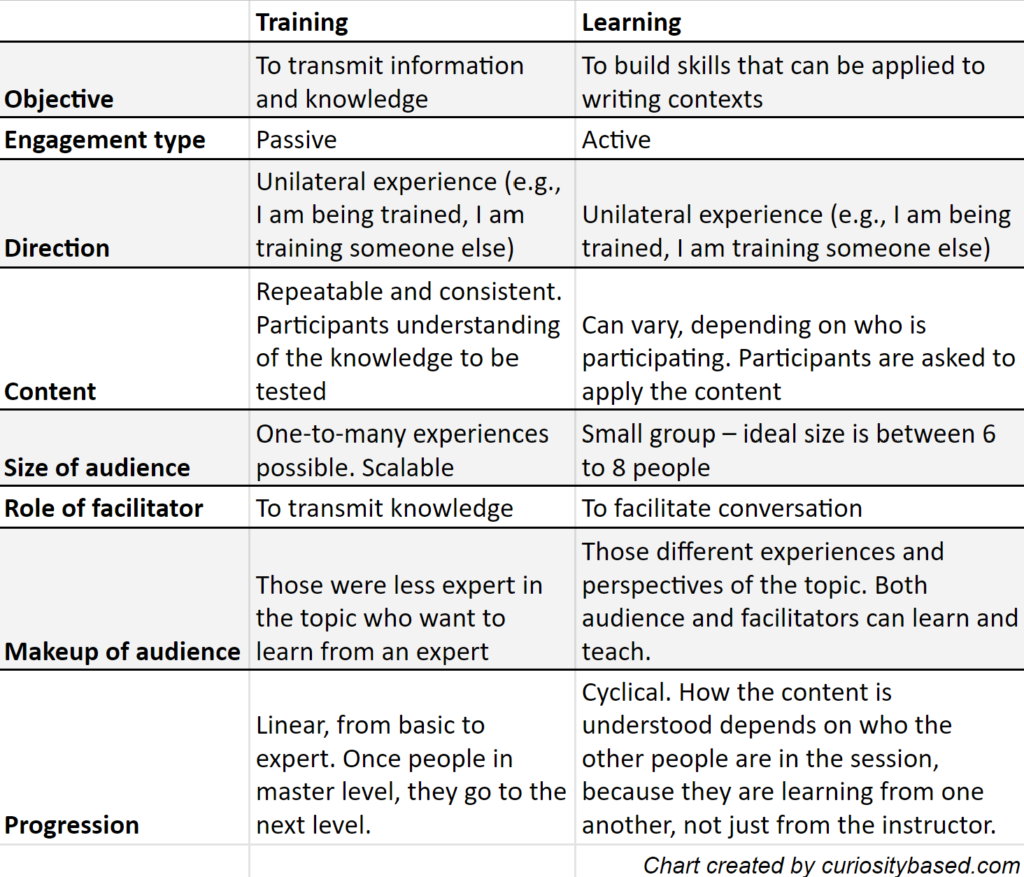
We assume that “training” and “learning” are the same, when they are not. Learn how they are different and which one is a better fit for your needs.
If you can’t explain the difference between training and learning, you aren’t alone. You likely use these words interchangeably, as I have, or know there is a difference, but you might struggle to explain what that difference might be. I looked up the definitions:
“Training” is about transmitting knowledge or information, while “learning” is about the process of absorbing information to build skills that can be used in a variety of contexts.
With “training,” you’ll get information. For a lot of people, getting information is enough, especially if you already know how to apply knowledge. “Learning” is equivalent to building critical thinking skills. A lot of people assume they’re the same when they’re not. You may also think of the difference between the two as “training” being “passive learning,” while “learning” is “active learning.”
Training Versus Learning
Employers say they want “training” for their teams. That might be because we often describe anything educational in the professional setting as “training.”
While I outline these two categories below, I understand that there are many professional development offerings that fall in between the two poles. There are many classes that provide training with strong learning elements to practice what is being taught.
I’m a big advocate for “learning” experiences over “training.” The difference can be summed up with this comment we heard from a participant in a learning experience I held on listening effectively. She said, “I’ve been to a lot of trainings about how to listen, where we just sat there, listening to the instructor tell us how to listen better. This is the first time I’ve spent practicing listening in a training about listening.”
Professional development is dominated by training to the point that if people don’t get a massive list of new vocabulary and worksheets, they don’t think they are learning anything new or valuable.
When I take people through a learning experience, I use the Socratic method, and I ask lots of questions to stimulate critical thinking and invite people to draw out their own learning. I’ve had people leave learning experiences I’ve led saying, “I now have more questions than answers.” That can be incredibly frustrating for some people, and eye opening and empowering for others.
At the end of a training session, If you asked the participants what they learned, the answers should be fairly consistent And they came to be tested on their knowledge. With the learning experience, I ask people to describe a take away. I’m always surprised by how people have different takeaways and I as a facilitator and content creator get to learn something as well. One person described this closing reflection as “naming our own meaning.”
Choosing What’s Right For You
There are times when training is the more appropriate choice and other times when learning is what is needed. These questions are designed to help you determine what you need to give to your team, especially while many of us are working remotely.
Do you need to deliver the same content to as many people as possible at one time or can you have multiple sessions with smaller groups of people?
Do you prefer people to something in a particular way or are you open to different ways of achieving the same/similar results?
Do you have deep trust across your different departments or are you looking to build more trust across silos?
Are your employees asking you for more content to help them do their work better or for more connection with each other?
Is your team or company made up of individual contributors or collaborators?
Do you want your team to have a shared language or a shared culture?
Are you prioritizing serving external clients or internal clients?
Are your team members more interested in listening passively or engaging actively?
If you mostly chose the first choice, then training is probably a better option for you. If your answers fell primarily toward the second choice, then you should explore learning experiences.
Prior to the pandemic, when we could be in person with one another, a good training was an efficient way to transmit substantial amounts of content. We took for granted the connection that came from being physically present together. Now, as we work remotely, taking the time to slow down and learn from and alongside one another allows colleagues to connect meaningfully. Before you default to training, explore what learning experiences could do for your team.
What I learned in managing expectations with others and with myself
Feb 1, 2022 to Jan. 21, 2023 marked the Year of the Tiger. This is a display at Wing Luke Museum.
In my second year as an entrepreneur, I learned a lot about how to manage expectations with others and especially managing my own expectations of myself.
Managing expectation is a never ending exercise in clearly articulating our needs, wants, and hopes. It requires activating all three elements of practicing curiosity: self- awareness, relationship building, and communication.
Here’s what I learned to help me navigate the dynamics of managing expectations that I’ve applied to both my personal and professional life.
Don’t expect people to change, yet believe them if they do change
Changing behavior is difficult for those who want to change, and impossible for those who don’t want to change. I’ve learned not to expect people to change. At the same time, people can change and I have to let go of grudges and old expectations to believe that they have changed. This has been especially true in my personal life. I’ve seen my mom change after my dad passed, in positive ways I didn’t expect. Just as I want others to see that I am capable of change, I have to be willing to believe others can change too, even if I shouldn’t expect it.
Explicitly describe what people can expect from me
I have to constantly remind myself that people can’t read my mind and I have to be more explicit. In regards to their own expectations, some people think in terms of what they will gain and benefit. For my clients, I describe what they will get with specific examples. For my team, I try to anticipate their questions and concerns. This is especially important now as people worry about layoffs. For my friends, I let them know what kind of support I can provide.
Explicitly describe what people shouldn’t expect from me
Other people think in terms of what they might lose or won’t get, so I also list what I won’t be doing and what they will not get, so that I can manage their expectations. For example, I often tell people my 7 Forms of Respect framework will NOT teach them how to be respectful, that it’s not like 7 Habits of Highly Effective People. For my team, I’ve made it clear that until we become consistently profitable, I can’t increase hours or provide more benefits. For my friends, I let them know when I can’t provide support in the ways they asked of me.
Accept that people will have expectations of me I can’t fulfill
It’s natural for people to make assumptions about me that lead to certain expectations. I have found that people often think because I’m a woman of color in leadership development, my work will focus on diversity, equity, and inclusion (DEI) when it doesn’t. I don’t get upset by this expectation; I just explain that I’m not a DEI expert.
Name incorrect expectations
Painful learning experiences made me learn how to name incorrect expectations before I reset their expectations. For example, I now sometimes start workshops with, “You may think this is racial justice training and it’s not. This is what we’ll be doing instead and why.”
Ask people to manage my expectations by managing theirs
In being clear that expenses outpaced revenue this past year, I tell my team that I understand they have to consider their individual financial needs because I don’t know when I can provide higher salaries. I just ask them to keep me updated if they do search for work elsewhere. When a team member left for a great career opportunity, I was not surprised. My expectations were managed.
Differentiate between expectations and hope
Entrepreneurship requires optimism. I was wildly overly optimistic in my revenue projections coming into my second year. I realized expectations should be based on my previous experiences to believe what is realistic and possible, not from strangers’ success stories I read on the Internet!
Don’t compare myself to others in creating expectations for myself
This is a hard one to admit that I do. I constantly have to remind myself not to compare. I have
close friends who are also authors of wildly successful books. As a self-published author without a long track record of prestigious publications or public speaking, I can’t apply the same expectations for success to myself. If I only look at those who I think have more, I will always feel I don’t have enough. So, I can’t compare.
Continue to do things I love even if they don’t meet my expectations
There are so many things I love doing, such as writing essays like this, that don’t meet my expectations of desired outcomes. I often remind myself that I don’t write because I expect a lot of views; I write to have an impact, even if that impact is limited to a few readers. Think about what things you love to do and that you would do no matter what, even if they don’t live up to your expectations. This lesson is also connected to the one on differentiating between expectations and hope (see lesson #7).
Lower my expectations to “good enough” so I can experiment faster
I sometimes slip into perfectionist standards. This past year, I pushed myself to create content with less and sometimes no outside editing before I post. I’ve been surprised by how my raw content can resonate with people, like my 2021 reflections on managing my energy instead of my time or my Instagram reel that went viral when I made fun of myself. This lesson is one I will lean into even more in 2023.
I’ve learned to accept that managing expectations is an iterative process in which I have to be asking questions and listening carefully to both others and to myself.
Changing my expectations of myself and of others is easy and hard at the same time. It’s easy because it doesn’t require any physical change or financial investment. Yet it is hard because it demands that I challenge my own beliefs.
I’ve developed a list of what I call “reframes,” that can help to spark our thinking and re-frame our expectations. A popular reframe is changing a thought from “I have to…” to “I get to…”
Instead of seeing a task like picking up your kids from school as a burden that “you have to do,” you might think of it as an opportunity that “you get to do.” It is a way to shift our perspective, especially when we feel stuck.
We often think of things as “a glass half empty” or as “a glass half full” situations. The classic framing of an optimist would consider the glass half full.
While I’m an unapologetically optimistic person, I don’t use reframing to trick myself into thinking positively. Instead, I reframe to explore different possible interpretations for any given situation, while also acknowledging that how I feel in any given moment will be influenced by external factors beyond my control.
The glass can be half empty and half full simultaneously. There is no particular “right” interpretation, just different.
All of these reframes I offer are opportunities to practice curiosity and to ask ourselves, is there another way to understand this situation, to examine our own expectations?
Reframing reminds us of all the different, contradictory feelings and thoughts we can hold at the same time.
I’ve loosely categorized these reframes into three buckets that align with how we at CuriosityBased describe the three elements of practicing curiosity:
1) increasing self-awareness (getting curious about myself)
2) building relationships (getting curious about other people and let them get curious about me)
3) communicating clearly (listening and asking questions with curiosity)
Each reframe is a set of two to three different interpretations of the same thing, usually stated as questions, as written below. Here they are:
Increase self-awareness (Get curious about myself)
What should matter to me?/What does matter to me?
What does success look like to me?/ What does success feel like to me?
Am I not being heard?/ Am I not getting what I want?
Am I Managing my energy /Am I managing my time?
Is this a problem to solve?/Is this problem teaching me something?
Is someone judging me/Am I judging myself?
What will I achieve?/What will I learn?
Am I feeling pain?/Am I feeling change?
Do I own my possessions?/Do my possessions own me?
Am I the victim?/Am I the persecutor?
They made me feel bad/I made myself feel bad
What should do in this situation?/What could do in this situation?/What would I do in this situation?
Building relationships (get curious about other people and let them get curious about me)
Is someone judging me?/Am I judging someone?
Am I waiting for an invitation?/Should I extend an invitation?
Are they asking me for something?/Are they offering me something?
Was I wrong?/Was I in the wrong?
Do I feel superior to…?/Do I feel inferior to…?
Does their behavior reflect disrespect?/ Does their behavior reflect a lack of respect?
Am I anti-(fill in the blank)? Am I pro-(fill in the blank)
Am I Code switching? Am I strategically adapting?
You make me whole/I am already whole
Was their intention good?/ Was their intention bad?/ What was their intention?
Is someone making assumptions about me?/ Am I making an assumption about them?
Communicate clearly (listening and asking questions with curiosity)
Do we have different perspectives?/ Do we have different approaches?
Do we have different values?/ Do we have different priorities?
What should we do?/ What could we do? What would we do?
Are we thinking of the present in this situation? Are we thinking of the future in this situation? Are we thinking of the past in this situation?
Are we talking about a need?/ Are we talking about a want?
What does success look like to us? What does success feel like to us?
Which of these reframes resonate with you? Do you have some reframes you’d like to share?
Simple, inexpensive vacation tips to help you rest and reconnect
When I decided to leave my executive job a few years ago, I had to make a lot of personal budget cuts so I could self-fund my company.
These constraints forced me to be more creative and scrappy. “Vacations” used to mean trips far from here. I would use this time to travel to Vietnam, Burma, England, the East Coast, the mid-West or at least California. I now “vacation” by reconnecting with friends who live 10, 20, at most 40 miles away.
Through these trips, I’ve deepened my appreciation for the natural beauty of local parks and waterfronts, as well as for the familiarity of long-time friendships.
I’ve put together a list of easy, low-cost hyperlocal travel tips, including guest-room hopping (i.e., upscale couch surfing). I hope they help you both rest and reconnect with yourself and with your friends.
Don’t over schedule/overbook My natural impulse is to try to do and see as many things with as many people as possible. I constantly have to remind myself that running to meet back-to-back visits is stressful. Also, leaving open space on my schedule allows for spontaneous activities. Recently, I went on a walk with a friend and then she asked me if I was available for dinner that night. And I was free!
Housesit for friends I recently house sat for a friend in her charming Columbia City home. It was a great way to change scenery for me, and I used it as an opportunity to visit with many of my friends in the area. She thought I was doing her a favor by watering her plants on a daily basis but I really felt like she was doing me the favor.
Invite yourself over for a meal or coffee I contact friends who live in the area where I’ll be vacationing and I invite myself over. People often thank me for initiating and breaking us out of the cycle of saying, “we should get together sometime.” For more, read my essay on “Being a bit rude can deepen relationships.”
Local sleepovers and guest room surfing My friend and website designer, Stacy Nguyen, and I have an annual summertime tradition of me coming over for a sleepover at her place in Lynnwood. I have since added more cities on this “Northern tour” of Washington by visiting friends in Edmonds and Marysville. I also do a 5-day long West Seattle trip so I can easily visit my friends out there. Fortunately, many of my friends have guest rooms, so I don’t have to couch surf. Bonus: Sleepovers allow for late night conversations.
Take walks I often suggest going for walks at local parks with friends whose neighborhood I’m visiting. It’s a free and healthy alternative to Happy Hour. I just discovered how delightful the illustrated Seattle Walk Report guides are.
My hyperlocal vacations usually involve me asking for friends to pick me up or drop me off at the bus stop or at another friends’ place, to plan a meal, to host me. These are not just people I’m visiting, they are helping make my vacation possible.
Let me know which tips you found helpful! And please share with me your own tips.
Learn From Your Cringe-Worthy Experiences, And Share Your Lessons
KUOW reporter Bill Radke, Julie Pham, and author Monica Guzman at a live, public talk on July 7, 2022 at McCaw Hall. This is an example of the public talk, but not the one I described in the essay.
There I was, presenting to a virtual audience of 100 people about my work, something I had talked about dozens of times before. I was excited. It was going to be my biggest audience yet.
Five minutes into my talk, an audience member asked why I was presenting on a topic that wasn’t relevant to the event’s theme. I explained. She pressed. I became defensive. Messages started to flow into the chat, criticizing the relevancy of my topic and flaws they perceived in my work.
An audience member said my presentation was a waste of his time. I worked hard to maintain my composure. I thanked him and acknowledged that my work wasn’t going to be relevant and fit everyone’s needs. I tried to move into the planned activity and get people into breakout rooms. I said I wanted to give people time to process. In reality, I needed a break. Chat messages questioning my motives kept pouring in.
Finally, the session ended. I tried to hold on as long as I could. Then I turned off my camera and cried. I cried out of disappointment, shame, frustration and resentment. And then I asked myself, “What did I learn?”
I don’t regret what happened. If I’d been warned ahead of time about what would happen at that event, I would have still done it. When I share the story, some people try to reason what should have been done to prevent the negative reaction. I have to explain that I’m grateful for the experience.
I learned more in that 75 minute session than I had in the dozens of times prior I presented on the topic. I wouldn’t change a single thing. Pain is a teacher.
Whenever something like this happens, I process the pain by learning from it.
So, I talked about the experience a lot, with my team, with friends, acquaintances, and people I volunteer with. I even talked about it with clients and potential clients.
When I share my pain, others learn too. I learn from their reactions and observations. I want to know their perspective. The learning spreads. And I model what it means to be willing to learn from my mistakes.
Sharing this experience has also resulted in something surprising. Many shared their own related painful, shameful experiences. They implicitly said, “I’m going to let my pain be your teacher too.” They reciprocated. Our trust deepened.
We all have difficult, cringe-worthy, experiences we don’t want to talk about.
What can happen when you share what you learned from the pain?
Others can learn from you, and you can learn from them. I’ve been doing this all my life.
It’s what allowed me to make rapid career changes. I went from being an academic to running a Vietnamese newspaper, to tech marketing, to nonprofit leadership, and then starting my own company last year.
My life has been a series of painful experiences that I rapidly learned from. My parents are an inspiration for me. As Vietnamese refugees, I watched them navigate America in their limited English. They had no choice but to get out and try and they knew that it wouldn’t be perfect, and they did it anyway. Over and over again.
When I was a grad student, I had to learn Vietnamese quickly. I didn’t grow up speaking it, so I had to learn as an adult. Within two years, I was volunteering to present in Vietnamese to Vietnamese researchers. I had a very heavy American accent and I’m sure that there are times when I made many grammatical mistakes. And I did it anyway.
I got my real-life MBA by returning to Seattle and running my family ‘s Vietnamese language newspaper. One of the things I had to learn was how to sell. So, I’d get on these calls with ad agencies, and they would ask me all of these questions and I just had to say, “I don’t know, I don’t know.” I remember after one particularly hard call, I told myself, “You are bad at this now, but you’re going to get really good in two years.” And I did get better.
I decided to leave the best job I ever had in the middle of the pandemic to start my own company called CuriosityBased. With my own team, I’m constantly taking risks to push our own learning. Here are two examples:
Whenever we are about to go into a workshop with new exercises, I remind the team, “Even though we’ve rehearsed this a lot, we’re going to make some mistakes. And when they happen, we just need to roll with it. We will learn.”
When I created my first digital course, we opted for speed over quality. We created a course in two weeks, which usually takes three months to do. Some early testers criticized the video quality as unprofessional. And yet I put it out in the world because I wanted to start the learning process. I wanted to hear thoughts and reactions.
One of the things that I’m most proud of is that I share what I learn with others and in doing so, I model learning in public.
People often ask, “What am I going to achieve?”
I ask, “What am I going to learn?”
Some people are motivated by the impact that they’re going to have on the world. My motivations are much more selfish. I’m motivated by what I’m going to learn and sharing what I learned with others in hopes that they will share with me their perspectives and what they’ve learned. I’m motivated to create a space for people to practice curiosity.
I want to return to the event I described earlier. Here’s some of my lessons:
I didn’t manage the audience’s expectations.
I didn’t think enough about what the audience wanted to learn
I was warned before the talk and brushed off other people’s concerns. I was naïve.
When confronted with questions about the relevancy of my topic, I got defensive.
I feared engaging in conflict in front of a live audience, so I retreated to the agenda
All of these mistakes have since made me a much better presenter and facilitator.
It’s not just about getting better and changing; it’s about getting clearer.
I learned to lean into what I do and what I don’t do. From the pain came clarity.
Not only did I learn what I can change, I also learned what I’m not willing to change because it’s core to who I am. There are some things I won’t apologize for.
And remember, pain is a teacher. You don’t have to experience learning alone.
The author sits with two leaders who constantly inspire her with how they practice curiosity: Robert Britten (left), executive director of Equity, Diversity, and Inclusion (EDI) at Lake Washington Institute of Technology, and Dr. Suzy Ames, president of Peninsula College (right).
I liken practicing curiosity to meditation – it looks easy, but it’s really hard. There are some days it’s easier to practice curiosity than other days. And yet when leaders practice curiosity, we can set the conditions for creativity, innovation, resourcefulness, resilience, and empathy for our teams.
I’ve worked in and with companies that ranged from three employees to more than 100,000. Something that any size company has in common is that culture is set from the top. Those in power determine what’s acceptable behavior. Leaders, keep in mind that your team members are watching what you do. They will follow what you do, not what you say you do.
Here are some tips on how leaders can practice curiosity themselves, which will have ripple effects in your organization. These tips are based on mistakes I have made, things I’ve learned in meetings and in everyday interactions.
1. Speak last in meetings
Often a leader’s opinion can have outsized impact, and can influence what other people feel comfortable sharing. I often declare that I’m going to give my opinion last, so that others can share theirs first, especially when we are brainstorming or giving feedback.
2. Let other people facilitate team meetings
There is an expectation that the team leader always has to run the meetings. By accident, I flipped this my first year in business because someone on my team wanted to practice facilitation. I said that she could set the agenda and facilitate our weekly team syncs. Having someone else set the agenda will encourage them to talk to other people on the team to find out what should be discussed. And they get an opportunity to shine. There are actually many meetings I don’t facilitate at all, when I don’t have a discussion topic to lead. I love this! Another approach is rotating the facilitator role, especially among those who might not be in leadership positions.
3. Admit when you’re wrong
When I make a bad decision or mistake, I own up to it. I had to do that recently because a team member wanted to institute a new project management tool. Because I didn’t want to learn a new tech tool, I said I wouldn’t use it but everyone else could. Five months later, only half the team was using the tool. I realized my resistance undermined my colleague’s efforts to streamline work processes. I apologized to her and I committed to using the tool. I could tell she was appreciative that I admitted I was wrong.
4. Show what you don’t know
Leaders don’t have to pretend to have all the answers because, in reality, we don’t. I often get asked, “What should we do?” and I reply, “I’m not sure. What do you think we should do?” Early on in my career, I thought I needed to have all the answers. I was so relieved when a boss modeled for me he didn’t always know and he would ask me to suggest solutions. Asking clarifying questions is also a way for leaders to model that it’s okay not to know the answers. I often ask “Can you give me an example of that?” “What does that word mean?” When you think others don’t know a concept, even if you do, ask for an explanation so that it benefits everyone.
5. Be aware of the possible impact of your questions
Power dynamics means that sometimes people see questions from leaders as directives. A friend of mine told me she serves on a nonprofit board. She described when she asked the executive director (ED) of that nonprofit some questions, that ED responded defensively. I pointed out to her that the ED may have interpreted the question as an order because she as a board member is technically her boss. It can be helpful to preface a question with, “I’m asking this to understand, not because I want you to change anything or do something different.”
6. Make time to care
I talked about this in an earlier essay about managing my energy vs. my time. At the beginning of every meeting, our team members share our personal highs and lows. We get to be curious about others and let them be curious about us; this reciprocity is critical to relationship building. I’ve shared my struggles with maintaining a prediabetic diet, how I miss my late father, and other things that are pulling me down. Studies even show that teams that share their personal lows are able to be more honest with one another when it comes to the work.
7. Ask questions when you’re upset
Feeling anger, resentment, fear, annoyance can become curiosity killers. I have to be extra intentional about asking questions when I’ve got those feelings, because my gut reaction is to assume bad intentions. A friend told me that he was upset with someone on his team for not following his directions. He felt deeply disrespected. I suggested he ask that colleague, “What’s your process for your work?” to understand how they approach work. Then follow up with, “What do you think about the process I’m asking you to do?” Curiosity can be the antidote to assuming bad intentions just perpetuates.
I hope you’ll try some of these tips. Let me know how it goes.
My 2021 Valentine Card concept. To capture the spirit of 2020, the theme was “silver linings.” The front of the card is a Zoom frame and the right square is black. I personalized each card by writing the recipient’s name in with white ink. The inside had the design of a Zoom chat window with a standard message sharing some silver linings I experienced in 2020. Below the fold was space for me to handwrite a personal message. I sent the card in a white envelope lined in silver, to add to the “silver lining” theme.
I get energy from interacting with other people. I organize social gatherings. I love meeting new people. In many ways, I’m a classic extrovert. When the quarantine started, I wondered how I would survive.
My social schedule went from 4-8 in-person meetings on any given day to none. For the first 5 month, because I lived alone, I didn’t see anyone, not my family, not my boyfriend through June. What surprised me was how some of my more introverted friends went stir crazy from the lack of human interaction and I was actually doing pretty okay.
I thought I’d be the one feeling super isolated. It has been the opposite. I do acknowledge that my lowest-scoring Love Language is touch, so I don’t actually need to physically be with people to feel connected to them.
While the rate of making new relationships has dropped a lot, I have deepened existing relationships exponentially.
There are many friends I would only see 1-2x a year who I now talk to regularly on the phone.
Although I appreciate large gatherings to increase the chances of meeting a stranger who might become a lifelong friend, my favorite form of connecting is 1:1 conversations, which I am still able to have virtually. And because I don’t have to worry about commute time, I’m actually able to connect socially with more people 1:1 on any given day than ever before.
So here are some tips for deepening relationships remotely. The quarantine amplified their impact.
Text message. I send a text to at least 5 acquaintances/casual friends a week. Send a text to say “happy birthday” or a “checking in…how are you?” I use Facebook to get reminders of people’s birthdays and updates on their lives. When I see a reminder, I check to see if I have that person’s phone number and if I do, I text message a happy birthday wish or a congratulations because it is so much more personal. It has sometimes led to long text exchange or even phone conversations to catch up. Most of the time, it just reminds people, “Someone is thinking about you.”
Email update. Once a year, I send out a long email update that I personalize with mail merge. My rule of thumb is if I can’t refer to a specific detail about that person’s life or the last time we interacted, I shouldn’t be emailing them. And to be real in the email, I include the happy and the hard stuff. I will usually include a small request, like check out a free workshop I’m piloting or an essay I just wrote to give me feedback. It’s my way of asking people to be part of my journey. I have gotten detailed responses from people, telling me about their lives.
Phone calls. I have regular weekly, monthly, and quarterly phone calls with friends now. I often take calls while I’m stretching or walking. I am on video conferencing so much that I love an old fashioned phone call and I know others often appreciate it too. I’ve said to people, “Hey, want to make this a regular thing?” Many are also ad hoc phone calls. There are some days I can reconnect with 4-7 different friends and acquaintances this way. I have one friend who I only met 2-3 times over two years before the quarantine and now we talk once a month. Another friend refers to our now monthly calls as “therapy.”
Send cards when people don’t expect them. Most people send their cards out in December. Since I was in high school, I have sent out Valentine cards because most adults don’t get Valentines. I express appreciation for friends who supported me during the previous year. I design each year’s card to recap the theme of the previous year and I’m particularly proud of this year’s concept. I still write at least 3-5 lines of a personal message in each card. Since I started using EE Printing ten years ago, I can send out about a 100 a year, limited by my ability to write personal messages. These have been great ways to reconnect with people.
I heard a great interview with Morra Aarons-Mele of Women Online by Guy Raz with more tips.
Even before the pandemic, I heard people complain about how difficult it is to develop new friendships or deepen existing ones, especially as an adult. People can act as if others are withholding friendship from them.
If you’re struggling to build or deepen relationships, it might be because you’re too polite.
Relationship building requires risk-taking. One person must initiate. You can wait around for other people, or do it yourself. I prefer to initiate. Sometimes my actions might be interpreted as rude. I’d rather take the risk that someone will perceive me as rude than do nothing at all. I’ve been turned down before, and I’m grateful I found out sooner rather than later that the person didn’t want to reciprocate.
Here are some tips that can help you deepen your relationships. Warning: They might be perceived as rude.
Just say “no” (instead of saying nothing of all)
It can be hard to say “no.” But there is something worse. And that’s not saying anything at all.
Think about how you feel when someone doesn’t respond to an invitation or request. I’ve sometimes asked for something from someone I know, and that person said nothing, even after a reminder. I wondered, did he or she think less of me? Did I ask too much? Did I cross a line? Some people think saying no is rude. I think it’s ruder to ignore someone.
That’s why when I can’t say “yes” to an invitation, I strive to decline as soon as possible. I don’t want to keep anyone waiting or guessing. Whenever someone says no to me, I immediately thank the person.
Yes, we’re all busy. That is not an excuse. Some of the best examples of a quick, firm, and kind decline came from some seriously busy people, including a Fortune 500 CEO and a county court judge. If they can take the time to say no, so can I. And the way they said no made me feel safe, as if I could still ask for something later, which I did and received a yes. “No” just means “not this time.” Silence often implies I shouldn’t have asked.
Takeaway: The next time a friend or an acquaintance asks you for something, and you know you can’t help, send a quick and kind decline instead of silence or pushing it off.
Ask for help (don’t just offer it)
It’s easy to offer help. It probably makes you feel good or helpful. When you are the one offering help, you have power. You determine how you will help. Most people often feel good about being asked for help.
Think about how you feel when you ask for help. If you are like most people I’ve talked to, you don’t like asking for help. You might even think it’s rude.
And yet asking for help is more likely to make someone feel connected to you than offering help. For example, I have developed deep friendships with people I asked for a ride to or from an event when they never offered.
Asking for something signals you want to continue the conversation with this person. I’m really testing to see how this person responds—will it be yes, no, or nothing at all? When the person doesn’t reply or deflects, even after I nudge a few times, then I’ve discovered an unspoken boundary.
When you attempt to deepen a relationship by asking for help, you may quickly learn the other person’s limits. At least you gave him or her a chance and now you know.
Takeaway: Think of what you can ask for from others. Try asking someone you want to have a deeper relationship with.
Ask that overly personal question (skip the small talk)
I hate small talk, especially if the conversation never moves beyond it.
If you like small talk, and it works for you, you might want to skip this tip.
Lately, I’ve been thinking about class-based assumptions (I’ve done a lot of research on assumptions). A meeting I planned to attend was canceled at the last minute. I decided to email the other person who I knew was attending. I asked to connect by phone so we could use the time we had already set aside. He sent me his number and I called him. After about five minutes, I decided to cut off the small talk and take a risk. I asked him how he would feel talking about his class background. As a result, we got into a deep conversation on a topic that he told me he hadn’t really talked about before, and we did become closer.
I tried the same question on another acquaintance a few months earlier. Once she realized I was asking her what she personally thought about class, she mumbled an answer and then told me she had to get off the phone to deal with an emergency. I suspect she thought I was rude.
In both cases, I took a risk with an acquaintance. Deepening one out of two relationships is pretty good odds. It was worthwhile to test my limits.
Takeaway: Try skipping the small talk and ask something that’s mildly overpersonal and see how the other person responds.
Invite yourself over
You’ve probably heard people say, “I’ll have to have you over some time.” You may have even said it yourself.
Consider inviting yourself as a way to take someone up on their explicit or implicit offer.
The other day, I decided to invite myself to a friend’s house. Once when we were at an Indian restaurant, he mentioned he makes good paneer and casually said I should come over sometime to try it out. So, I text messaged him, “My boyfriend and I would love to come over for that homemade paneer you mentioned.” He immediately asked me when I was free and set a date. We ended up having a great three-hour conversation, and he said we should get together again.
When you invite yourself, it signals, “I believe your offer was sincere, and I want to spend time with you.” It’s a bold move, some might even say rude. I’ve done this with people who have offered and even those who haven’t. For example, I asked a friend who I know often hosts friends and family from out of state if I could have a “staycation” with her for a few nights. She agreed and we talked late into the night about many things we usually can’t squeeze into our regular phone calls. She offered to host again.
If you invite yourself and the person hesitates or deflects your invitation, you might realize it was just a polite but superficial offer to begin with. You can gently retract by not pushing the issue further.
Takeaway: Think about someone who has offered hospitality to you that you genuinely want to get to know better. Try inviting yourself over.
What some people consider rude, I see as taking a risk. And if someone really wants to reciprocate and deepen a relationship with you, he or she will recognize your effort.